
Choosing the right dentist SEO company can influence how effectively a dental practice reaches prospective patients through organic search. A well-planned SEO strategy can improve relevant search visibility, strengthen important service pages, support local discovery, and create a better foundation for long-term online growth.
However, choosing an SEO provider should involve more than comparing prices or listening to ranking promises. Dental practices need a company that understands search intent, local SEO, website optimization, technical SEO, content quality, and the relationship between online visibility and meaningful patient enquiries.
This guide explains what a dentist SEO company does, which services to consider, how to evaluate potential providers, what warning signs to avoid, and what dental practices should know before making a decision.
Table of Contents
- What Is a Dentist SEO Company?
- What Does a Dentist SEO Company Actually Do?
- Dentist SEO Services to Look for in an SEO Company
- How to Choose the Right Dentist SEO Company
- Red Flags to Avoid When Hiring a Dentist SEO Company
- How a Dentist SEO Company Measures Progress
- How Long Does Dentist SEO Take to Work?
- How Much Does a Dentist SEO Company Cost?
- Dentist SEO Company vs. Doing SEO In-House
- When Should a Dental Practice Hire an SEO Company?
- Specialized SEO for Different Dental Practices
- Questions to Ask a Dentist SEO Company Before Hiring
- Building a Long-Term SEO Strategy for a Dental Practice
- Final Checklist for Choosing a Dentist SEO Company
- Conclusion
What Is a Dentist SEO Company?
A dentist SEO company is an SEO provider that helps dental practices improve their visibility in relevant organic and local search results.
Rather than relying entirely on paid advertising, SEO focuses on improving a practice’s website and online presence so search engines can better understand its services, location, content, and relevance to users.
Depending on the practice and its goals, an SEO company may work on:
- Keyword research
- On-page optimization
- Local SEO
- Technical SEO
- Content strategy
- Internal linking
- Website performance
- Digital authority
- SEO reporting
The exact scope varies between providers, which is why practices should understand what a company will actually do before signing a contract.
For broader background, practices can explore SEO strategies for dental practices.
Why Dental Practices Need Specialized SEO
Dental searches often have strong local and service-specific intent. One person may search for a nearby general dentist, while another may be looking for information about a particular treatment.
Common searches can include:
- Dentist near me
- Family dentist in a specific city
- Emergency dental care
- Teeth cleaning
- Dental implants
- Cosmetic dentistry
- Root canal treatment
- Children’s dental care
These searches represent different needs and stages of the patient journey. A good SEO strategy should account for those differences rather than treating every search as the same.
What Does a Dentist SEO Company Actually Do?
A professional SEO company should first understand the dental practice, its services, target locations, website, competition, and business objectives.
The resulting strategy may involve several connected areas.
Dental Keyword Research
Keyword research helps identify the searches that are relevant to a dental practice.
A thoughtful process considers:
- Treatment-related searches
- Location-based searches
- Service-specific terms
- Informational questions
- Commercial search intent
- Variations in how people describe dental services
The purpose is not to insert keywords into every paragraph. Instead, keyword research should help determine which topics, services, and pages deserve useful and well-structured content.
Website Optimization
A dental website should be easy for both users and search engines to understand.
An SEO company may review:
- Page titles
- Meta descriptions
- Heading structure
- Service pages
- URL structure
- Internal links
- Images
- Navigation
- Mobile usability
- Calls to action
Important pages should have a clear purpose and provide information that helps visitors understand the practice and its services.
Local Search Optimization
Local visibility is particularly important for dental practices because many prospective patients look for providers within a specific geographic area.
Local SEO can involve improving location relevance, business information, website content, and other elements that help users discover a nearby practice.
The focus should be on useful local information rather than creating large numbers of thin or repetitive location pages.
For more information, see improving local visibility for dentists.
Dental Content Strategy
Content gives a dental website an opportunity to answer patient questions and explain services in greater depth.
Useful resources may include:
- Treatment guides
- Service explanations
- Frequently asked questions
- Preventive dental information
- Preparation and aftercare information
- Practice-specific resources
- Educational articles
Content should be accurate, original, understandable, and written primarily to help people.
Publishing a large number of generic articles does not automatically create a strong SEO presence. Relevance, usefulness, accuracy, and appropriate organization are more important than producing content simply to increase word count.
Technical SEO
Technical SEO helps search engines access, crawl, understand, and index a website effectively.
An SEO company may evaluate:
- Crawlability
- Indexing
- Site architecture
- Broken links
- Redirects
- Mobile usability
- Page performance
- Structured data
- Duplicate content
- Canonicalization
Website performance is also part of the broader user experience. Practices can use checking website experience metrics when reviewing page performance.
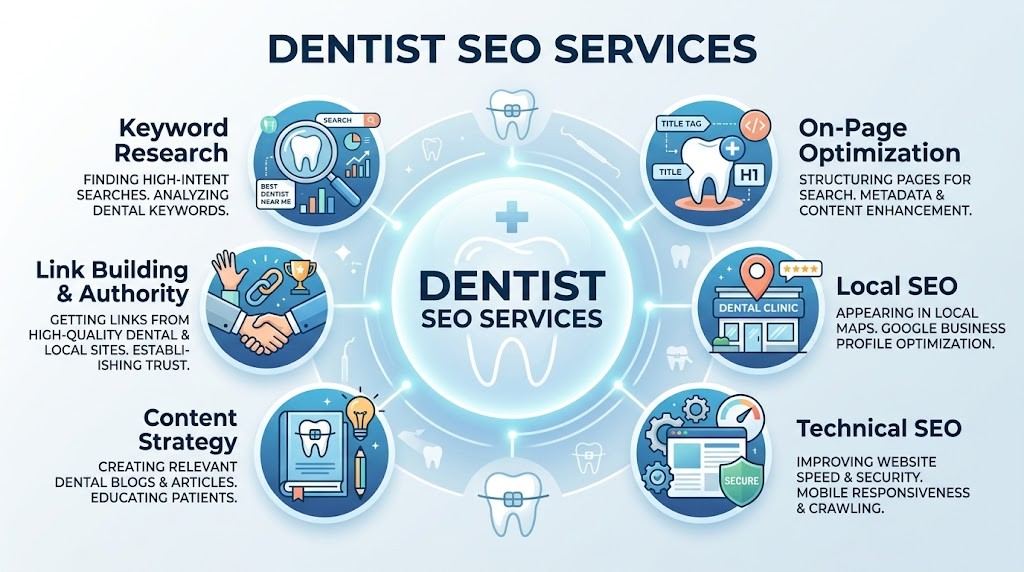
Dentist SEO Services to Look for in an SEO Company
Not every dental practice requires the same SEO package. A single-location practice may have different priorities from a larger organization operating multiple locations.
Instead of selecting a package because it contains a long list of services, evaluate whether the proposed work addresses the practice’s actual needs.
On-Page SEO
On-page SEO can involve optimizing:
- Titles
- Headings
- Page content
- Internal links
- Images
- URLs
- Meta information
- Service pages
The objective is to make pages clearer and more useful while helping search engines understand their topics.
Local SEO
Local SEO focuses on improving a practice’s visibility for relevant searches connected to its service area.
Work may include:
- Local website optimization
- Business information
- Location relevance
- Local content
- Reputation-related considerations
- Local search visibility
Technical SEO
Technical SEO can identify website issues that may affect crawling, indexing, usability, or performance.
A good provider should base technical recommendations on an actual audit rather than applying the same checklist to every dental practice.
Content Optimization
An SEO company may improve existing content and develop new resources based on search intent.
Useful content should answer the user’s question clearly and provide enough context to be genuinely helpful.
Link Building and Digital Authority
Relevant links from trustworthy websites can contribute to a site’s broader authority and discoverability.
However, dental practices should be cautious about providers that emphasize backlink quantity without explaining where those links will come from or why they are relevant.
A sustainable approach focuses on relevance, quality, and legitimate editorial opportunities rather than link volume alone.
SEO Audits and Competitor Research
An SEO audit can uncover opportunities across technical SEO, content, website structure, and local visibility.
Competitor research can also help identify:
- Services competitors emphasize
- Topics they cover
- Website structures they use
- Potential content gaps
- Relevant search opportunities
Practices can learn more about the broader service category through professional dental SEO services.
How to Choose the Right Dentist SEO Company
Selecting an SEO provider requires more than comparing monthly fees.
Look for Dental Industry Experience
Experience with dental practices can be valuable because the provider may understand common dental services, local competition, patient search behavior, and the structure of dental websites.
Ask potential providers for specific examples of previous work and clarify exactly what they were responsible for.
Review the SEO Strategy Before Signing
A reputable company should be able to explain its proposed approach.
Ask:
- What should be improved first?
- Which pages will be optimized?
- What content will be created?
- How will local visibility be addressed?
- Which technical issues require attention?
- How will progress be evaluated?
The strategy should be based on the practice’s actual situation rather than a generic package.
Ask About Communication and Reporting
Clear communication makes an SEO campaign easier to understand and evaluate.
Ask how frequently reports are provided and whether the company explains:
- What work was completed
- What changed
- What the data indicates
- What problems were discovered
- What will be prioritized next
Reports should be understandable to practice owners and decision-makers rather than relying entirely on unexplained SEO terminology.
Evaluate Case Studies Carefully
Case studies can provide useful evidence, but they should be reviewed critically.
Look for information about:
- The starting situation
- Work performed
- Search visibility changes
- Organic traffic trends
- Lead or enquiry changes where measurable
- The timeframe involved
A screenshot showing a ranking position alone does not demonstrate the full value of an SEO campaign.
Understand the Contract and Pricing
Before signing an agreement, clarify:
- Monthly cost
- Setup fees
- Contract length
- Cancellation terms
- Included services
- Content costs
- Link-building costs
- Reporting frequency
- Website development charges
A lower monthly price may not represent better value if important work is excluded.
Red Flags to Avoid When Hiring a Dentist SEO Company
Dental practices should be cautious when an SEO provider makes unrealistic or overly broad promises.
Guaranteed #1 Rankings
Search rankings can change because of competition, search behavior, website changes, algorithm updates, and other factors. A provider should not present a permanent first-place ranking as something it can guarantee.
Unrealistic Timelines
SEO is generally an ongoing process. Some improvements may appear relatively quickly, while competitive searches can require sustained work over a longer period.
Large Quantities of Low-Quality Backlinks
A high number of backlinks does not automatically indicate a strong SEO strategy. Poor-quality or irrelevant links may provide little meaningful value.
Generic or Low-Quality Content
Publishing large amounts of repetitive content is not a substitute for useful resources that address genuine patient questions.
No Clear Reporting
If a provider cannot explain what it is doing or how progress will be evaluated, it becomes difficult for a practice to assess the campaign.
One-Size-Fits-All Strategies
Dental practices differ in location, services, competition, website condition, and business objectives. A strategy that ignores those differences may not address the most important opportunities.
How a Dentist SEO Company Measures Progress
SEO performance should be evaluated using multiple indicators rather than a single ranking position.
Organic Search Visibility
Search visibility can help show whether a website is appearing for relevant searches.
Rankings can be useful, but they should be considered alongside impressions, clicks, organic traffic, conversions, and the relevance of the searches generating that visibility.
Website Engagement
Organic traffic should be evaluated in context.
Useful questions include:
- Which pages receive organic visits?
- Are visitors reaching important service pages?
- Which searches are generating traffic?
- Are high-value pages gaining visibility?
- Are visitors taking meaningful actions?
Leads and Patient Enquiries
For a dental practice, business outcomes are important.
Depending on the website and tracking setup, useful conversion indicators can include:
- Appointment requests
- Contact forms
- Phone enquiries
- Consultation requests
- Other meaningful conversion actions
SEO does not guarantee that every visitor will become a patient. Conversion performance should therefore be considered alongside visibility and traffic.
Measuring Organic Search Visibility
Google Search Console can provide useful information about how a website performs in Google Search, including queries, impressions, clicks, and other search-performance data.
Practices can use measuring organic search visibility as one part of a broader SEO measurement process.
Search performance data can help identify trends, but it does not explain every reason for a ranking change. Competition, website updates, content changes, technical issues, and search behavior can also influence performance.
How Long Does Dentist SEO Take to Work?
SEO is usually a long-term process rather than an instant marketing tactic.
The time required to see meaningful changes can vary according to:
- Website condition
- Local competition
- Geographic market
- Existing authority
- Content quality
- Technical issues
- Current search visibility
- Resources available for implementation
- Overall campaign scope
Some technical improvements may produce relatively quick changes, while competitive service terms may require consistent work and evaluation over a longer period.
A responsible SEO company should set realistic expectations rather than promising a specific ranking within a fixed timeframe.
How Much Does a Dentist SEO Company Cost?
There is no single price that applies to every dental practice.
SEO costs can vary based on:
- Practice size
- Number of locations
- Geographic competition
- Number of services
- Website size
- Technical requirements
- Content requirements
- Authority-building activities
- Reporting requirements
- Overall campaign scope
A small local practice may require a different level of investment from a multi-location dental organization competing across several markets.
What Should Be Included in an SEO Package?
Depending on the provider and campaign, an SEO package may include:
- Initial SEO assessment
- Keyword research
- Technical recommendations
- On-page optimization
- Local SEO
- Content strategy
- Content optimization
- Internal linking
- Authority-building activities
- Performance reporting
- Ongoing strategy adjustments
Always confirm what is actually included before comparing providers based on price alone.
Dentist SEO Company vs. Doing SEO In-House
Some dental practices may prefer to manage SEO internally, while others may benefit from working with an external provider.
| Factor | SEO Company | In-House |
| Expertise | Access to specialized SEO knowledge | Depends on internal staff |
| Resources | Often broader SEO tools and skills | Limited by internal resources |
| Scalability | Can generally scale with campaign needs | May require additional hiring |
| Cost structure | Ongoing service cost | Employee, training, and tool costs |
| Strategy | External SEO expertise | Greater internal control |
Neither approach is automatically better.
The right choice depends on the practice’s available staff, budget, technical knowledge, goals, and willingness to manage SEO internally.
When Should a Dental Practice Hire an SEO Company?
A dental practice may benefit from professional SEO support when:
- Its website receives little organic traffic
- Competitors consistently appear ahead for important searches
- Key services have weak search visibility
- The practice is entering a competitive local market
- The website has unresolved technical issues
- The practice is expanding its services
- The internal team lacks SEO expertise
- Previous SEO work produced unclear results
- The practice wants a structured long-term search strategy
Hiring an SEO company does not have to be about fixing a single problem. It can also provide ongoing strategy, implementation, monitoring, and improvement.
Specialized SEO for Different Dental Practices
Dental practices do not all serve the same audiences or offer the same services.
A general dental practice may focus on examinations, cleanings, fillings, restorative dentistry, and preventive care.
Other practices may specialize in:
- Pediatric dentistry
- Cosmetic dentistry
- Orthodontics
- Oral surgery
- Emergency dentistry
- Implant dentistry
Each specialty can have different audiences, services, search intent, and content requirements.
For example, a pediatric practice may need a more specialized SEO approach because its content and search intent can differ from those of a general dental practice. Learn more about SEO for pediatric dental practices.
The important point is that specialization should influence the strategy instead of forcing every dental website into the same content model.
Questions to Ask a Dentist SEO Company Before Hiring
Before choosing a provider, dental practices should ask practical questions such as:
- Have you worked with dental practices before?
- What would you improve on our website first?
- How do you approach local SEO?
- How do you research dental keywords?
- How do you develop dental content?
- Which SEO metrics do you report?
- How frequently will we receive reports?
- Who will actually perform the SEO work?
- What is included in the monthly fee?
- Are there additional content or link-building costs?
- Is there a minimum contract period?
- How do you adjust the strategy if results are not meeting expectations?
- Do you guarantee rankings?
The answers can reveal whether a provider has a thoughtful process or is primarily selling a standardized package.
Building a Long-Term SEO Strategy for a Dental Practice
Dental SEO generally requires ongoing attention.
Search competition changes, websites evolve, services are added, and existing content can become outdated. A strong strategy should therefore be reviewed and adjusted over time.
Long-term activities may include:
- Updating important service pages
- Creating useful educational resources
- Improving technical performance
- Strengthening internal links
- Monitoring search visibility
- Evaluating competitors
- Improving local relevance
- Reviewing conversion paths
- Identifying new search opportunities
SEO should also work alongside the practice’s broader marketing strategy rather than operating in isolation. Practices interested in this wider relationship can explore SEO-driven dental marketing.
Final Checklist for Choosing a Dentist SEO Company
Before hiring an SEO provider, consider whether the company offers:
- ✓ Relevant dental industry experience
- ✓ A clear and customized SEO strategy
- ✓ Local SEO knowledge
- ✓ Strong technical SEO processes
- ✓ A quality-focused content approach
- ✓ Transparent reporting
- ✓ Realistic expectations
- ✓ Clear pricing and contract terms
- ✓ Consistent communication
- ✓ No unrealistic ranking guarantees
- ✓ A focus on relevant traffic and meaningful business outcomes
Conclusion
Choosing the right dentist SEO company is ultimately about finding a provider that understands both search optimization and the practical needs of a dental practice.
A strong provider should be able to explain its strategy, identify meaningful opportunities, improve important website pages, create relevant content, address technical issues, and communicate progress clearly.
Dental practices should therefore evaluate providers based on experience, transparency, service scope, communication, and the quality of their proposed strategy rather than choosing solely on price or ranking promises.
The goal of SEO is not simply to appear higher in search results. It is to improve relevant visibility, help prospective patients find useful information, and build a stronger online foundation for the practice over time.


