

For a dental practice, having a professional website is only the starting point. Potential patients may search for a dentist by location, look for a particular treatment, research their options, or seek answers to dental questions before deciding which practice to contact.
That is where search engine optimization can become an important part of a broader digital strategy.
A dentist SEO agency can help a practice evaluate its website, identify relevant search opportunities, improve important pages, address technical problems, strengthen local search visibility, develop useful content, and monitor organic search performance.
However, choosing an SEO agency should involve more than comparing promises or looking for a provider that claims it can quickly reach the top of search results. Dental practices have different services, locations, audiences, websites, and competitive environments, so SEO strategies need to reflect those differences.
The right SEO partner should be able to explain what it plans to do, why the work matters, how progress will be evaluated, and what the practice can realistically expect.
This guide explains what a dentist SEO agency does, what services may be included, how a dental SEO strategy can be developed, what questions to ask before hiring a provider, how pricing can vary, what reporting should contain, and which practices should raise concerns.

A dentist SEO agency can provide specialized search strategy, optimization, and ongoing support for a dental practice.
What Is a Dentist SEO Agency?
A dentist SEO agency is an SEO provider that specializes in helping dental practices improve their visibility in relevant organic search results.
Its work may include technical website optimization, keyword and search-intent research, service-page improvements, content planning, local SEO, internal linking, website structure, authority development, and ongoing performance analysis.
Dental SEO requires more than simply understanding general SEO principles. A dental practice may serve a particular geographic area, offer several treatments, operate multiple locations, or target different audiences. The website needs to reflect those realities.
Search intent is also important. Someone searching for a local dentist may be ready to contact a practice, while someone searching for information about a treatment may still be researching their options.
This is why SEO for dentists should connect search behavior with the practice’s actual services, locations, website structure, and audience.
For a broader introduction to the subject, broader dental SEO guidance can provide additional context on the wider role of search optimization for dental practices.
A professional agency should therefore focus on making the website clearer, more useful, technically accessible, and relevant to appropriate searches rather than simply increasing keyword frequency.
Why Would a Dental Practice Work With an SEO Agency?
Hiring an SEO agency is not automatically necessary for every dental practice.
Some practices may have an internal marketing team with enough time and expertise to manage SEO themselves. Others may prefer outside support because search optimization involves several specialized disciplines.
A practice may consider professional SEO support when it has:
- Limited internal marketing time
- Little specialist SEO knowledge
- A technically complex website
- Multiple services or locations
- Significant local competition
- A need for ongoing content development
- Technical issues that require attention
- A need for structured SEO reporting
SEO also requires ongoing evaluation. Search behavior changes, websites evolve, competitors publish new content, and previously effective pages may need refinement.
An agency can provide a structured process for managing these areas.
There are limitations, however. An SEO provider does not know a practice’s patients, services, clinical approach, or business priorities as deeply as the dental team does. Effective SEO often works best when the agency and practice share information and communicate regularly.
The decision should therefore be based on available resources, internal expertise, website requirements, and business priorities—not on the assumption that every practice needs an agency.
What Does a Dentist SEO Agency Do?
The exact scope differs between providers, but professional dental SEO commonly covers several interconnected areas.
SEO Audits
An SEO audit establishes a picture of the website’s current condition.
Depending on the provider, an audit may review:
- Technical issues
- Indexing
- Crawlability
- Page structure
- Content quality
- Duplicate content
- Internal links
- Website architecture
- Mobile usability
- Local SEO opportunities
The useful part of an audit is not simply identifying problems. A good audit should help the practice understand which issues deserve attention first and why.
Keyword Research
Keyword research identifies search topics that are relevant to the practice.
Dental research may consider:
- Dental services
- Treatment searches
- Location-based searches
- Informational queries
- Commercial searches
- Emergency-related searches
- Patient questions
The objective should not be to collect the largest possible keyword list.
Instead, keywords should be evaluated according to relevance, intent, competition, location, and the type of page that can best satisfy the search.
A treatment-related query may be appropriate for a service page, while a question about preparation or aftercare may be better addressed through educational content.
On-Page Optimization
On-page SEO improves how individual pages communicate their purpose to both visitors and search engines.
It can include:
- Page titles
- Headings
- Content structure
- URLs
- Internal links
- Image optimization
- Relevant terminology
- Meta descriptions
Good on-page optimization should make information easier to understand.
A service page should explain the service clearly instead of repeating the same keyword throughout the page simply to increase keyword frequency.
Technical SEO
Technical SEO addresses the systems and structures that help a website remain accessible and usable.
An agency may review:
- Crawlability
- Indexing
- Mobile usability
- Website performance
- Redirects
- Broken links
- HTTPS
- Site architecture
- Image optimization
Technical SEO is particularly useful when a website has accumulated outdated pages, structural issues, broken links, or unnecessary redirects over time.
Local SEO
Local SEO can be especially relevant to dental practices because many potential patients look for services in a particular area.
An agency may review:
- Google Business Profile information
- Business details
- Location relevance
- Contact information
- Service information
- Location pages
- Review management
The aim is to make the practice’s services and geographic relevance clear without creating artificial or repetitive local content.
Content Strategy
An agency may also develop a content strategy around the questions and needs of the practice’s intended audience.
Potential content can include:
- Service pages
- Treatment guides
- Educational articles
- Frequently asked questions
- Preventive dental resources
- Patient-focused explanations
- Topic-cluster content
The strongest strategy is not necessarily the one that publishes the most articles. Content should have a clear purpose and provide information that is genuinely useful to the people the practice wants to reach.
Authority Development
Some agencies also help with broader authority development.
Responsible approaches may include earning relevant mentions, creating useful resources, developing legitimate publisher relationships, and improving the overall quality and credibility of the website.
Practices should be cautious of providers that focus on large quantities of generic backlinks or automated link-building packages. Link volume by itself does not establish meaningful authority.
Dentist SEO Services an Agency May Provide
SEO packages can vary considerably between agencies.
One provider may concentrate on technical SEO and website structure, while another may place more emphasis on content, local SEO, or ongoing optimization.
Potential dental SEO service options may include:
- Technical SEO
- Local SEO
- Keyword research
- Search-intent analysis
- Content strategy
- Content optimization
- Service-page optimization
- Internal linking
- Website structure improvements
- Performance monitoring
- SEO reporting
Practices should look beyond the name of each service and determine exactly what is included.
For example, “content optimization” might involve reviewing existing pages, rewriting sections, improving page structure, or developing an entirely new content plan.
Likewise, “technical SEO” might mean an initial audit or ongoing implementation of technical improvements.
A clear scope of work makes it easier to compare providers and understand what the monthly investment actually covers.
Local SEO and Reputation Management
Local search can be an important part of a dental practice’s online presence.
Potential patients may want to know where a practice is located, how to contact it, what services it provides, and whether other patients have shared genuine experiences.
An agency may therefore review the accuracy and consistency of important practice information, including:
- Business name
- Address
- Phone number
- Website
- Opening information
- Services
- Location details
Reviews also contribute to how prospective patients perceive a practice.
A responsible provider should never recommend fabricated reviews or misleading reputation tactics. Practices can review Google’s guidance on customer reviews when considering appropriate ways to manage customer feedback.
Reviews should be treated as part of a wider reputation and local-search strategy rather than as a single factor that determines search rankings.
Location strategy also deserves careful attention. A practice genuinely serving multiple communities may need useful location-specific pages, while creating numerous near-identical location pages can produce a poor experience and add little value.
Technical SEO and Website Performance
An SEO agency may spend considerable time examining the technical condition of a dental website.
A website should be accessible, usable across devices, logically organized, and capable of allowing important content to be discovered and processed appropriately.
Technical reviews may include:
- Mobile experience
- Page performance
- Crawlability
- Indexing
- HTTPS
- Broken links
- Redirects
- Site architecture
- Image optimization
A website performance testing tool can help identify potential performance opportunities and technical issues that may deserve investigation.
However, performance testing is only one part of a technical SEO review. A strong performance score does not automatically mean that a website has excellent content, strong search intent alignment, or appropriate local relevance.
Technical improvements should therefore support the broader website and SEO strategy.
How a Dentist SEO Agency Builds a Strategy
A strong SEO strategy should begin with understanding the dental practice rather than applying the same checklist to every client. The process typically involves several connected stages, from business and website research to technical optimization, local SEO, content development, and ongoing performance monitoring.
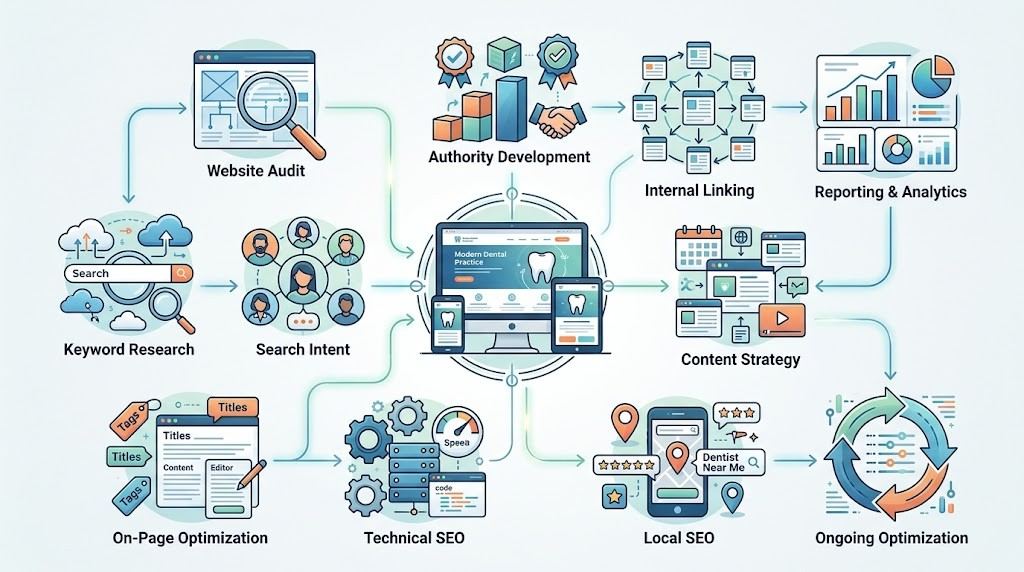
1. Business Discovery
The agency learns about the practice, its services, locations, audience, priorities, website history, and existing marketing activity.
This context helps ensure that SEO recommendations support the actual business rather than an abstract keyword strategy.
2. Website Audit
The existing website is reviewed for technical, structural, content, usability, and search-related issues.
The audit provides a starting point for prioritizing future work.
3. Competitor Research
Competitor research helps the agency understand how other practices approach services, content, local visibility, and website organization.
The purpose is to identify opportunities and competitive realities, not to copy competitors.
4. Keyword Research
Relevant search topics are identified based on the practice’s services, locations, treatments, and audience.
Relevance should remain more important than building an unnecessarily large keyword database.
5. Search-Intent Analysis
Search terms are examined to understand what users are trying to accomplish.
This helps determine whether a topic belongs on a service page, educational article, location resource, FAQ, or another page type.
6. Website Structure Review
The agency evaluates how important pages are organized and connected.
Navigation, URLs, page hierarchy, internal links, and unnecessary duplication can all be considered.
7. On-Page Optimization
Important pages are improved through better titles, headings, content structure, internal links, images, and other relevant elements.
8. Technical SEO
Technical problems identified during the audit are prioritized and addressed.
This can include indexing, crawlability, redirects, broken links, mobile usability, performance, and architecture.
9. Local SEO
The agency reviews local search elements and ensures that the practice’s information is presented accurately and consistently.
10. Content Planning
Content opportunities are identified according to the practice’s services and audience.
Existing content may be improved before new pages are created.
11. Authority Development
Where appropriate, the strategy may include legitimate methods for developing broader website authority.
Relevance and quality should be more important than simply acquiring large numbers of links.
12. Monitoring and Refinement
SEO performance is monitored over time.
The agency can use available data to identify opportunities for further technical improvements, content refinement, page optimization, or strategic changes.
Dentist SEO Agency vs. Doing SEO In-House
Both approaches can work. The right choice depends on the practice.
In-House SEO
Managing SEO internally can provide:
- Direct control
- Immediate access to practice information
- Strong internal business knowledge
- Close coordination with the marketing team
However, SEO requires a broad skill set.
An internal team may need knowledge of technical SEO, content strategy, keyword research, local SEO, website architecture, analytics, and search behavior.
Training staff or hiring dedicated specialists can also require significant time and resources.
SEO Agency
An agency may provide:
- Specialized SEO knowledge
- Technical expertise
- Structured processes
- Content support
- Local SEO experience
- Reporting systems
- Ongoing optimization
External support also introduces a cost and requires communication between the agency and practice.
A dental practice should therefore avoid assuming that an agency is always better than an internal team. The most appropriate option depends on available expertise, time, budget, website complexity, and the practice’s objectives.
SEO and Dental Marketing Through Search
SEO is best understood as one component of broader dental marketing rather than a replacement for every other channel.
A practice may combine organic search with:
- Content marketing
- Paid search
- Social media
- Email marketing
- Branding
- Reputation management
Each channel can serve a different purpose.
Organic search can help users discover useful information through search engines, while paid advertising can provide immediate visibility for selected campaigns. Social media can support communication and awareness, while email can help maintain relationships with existing audiences.
A broader dental marketing through search strategy can consider how organic search fits alongside these activities.
The important point is that SEO should support the practice’s wider marketing objectives rather than operate in isolation.
How to Evaluate a Dentist SEO Agency
Selecting an SEO provider requires more than checking a portfolio or reading a list of services.
Relevant Dental SEO Experience
Industry experience can help an agency understand dental services, local search behavior, patient-focused content, and common website structures.
Ask what type of dental SEO work the provider has actually handled.
Clear Strategy
The agency should be able to explain its general process and priorities.
You should understand what areas it intends to work on and why those areas are relevant to your practice.
Transparent Deliverables
The agreement should clearly state what the agency will provide.
This may include technical audits, page optimization, content work, local SEO, reporting, and strategy reviews.
Communication
Find out how updates will be handled and who will answer questions.
Consistent communication can make it easier to address website changes, new services, business priorities, and unexpected technical issues.
Reporting
Reports should explain what was completed and what the available data suggests.
A report consisting only of ranking screenshots may provide less useful information than one that explains search visibility, website performance, completed work, and relevant changes.
Technical Capability
The provider should understand technical SEO fundamentals and be able to identify issues beyond keywords and content.
Content Quality
Dental content should be accurate, useful, original, understandable, and appropriate for its intended audience.
Local SEO Knowledge
The agency should understand geographic relevance, business information, location strategy, and responsible review management.
Ethical Link-Building Practices
Ask how backlinks are approached.
Be cautious about providers that sell large quantities of generic links or suggest that a specific number of backlinks will guarantee search performance.
Contract Terms
Review the agreement carefully.
Pay attention to:
- Contract length
- Cancellation terms
- Deliverables
- Reporting
- Communication
- Content ownership
- Website access
- Additional fees
A practice comparing providers should approach dental SEO company selection by comparing expertise, strategy, scope, transparency, and expectations—not simply the lowest price.
Questions to Ask Before Hiring an SEO Agency
Before signing an agreement, a practice should be comfortable asking specific questions.
What SEO Work Will You Perform?
This helps determine whether the provider has a defined process or is relying on vague promises.
What Will Be Included Each Month?
Ask for specific deliverables rather than broad service descriptions.
How Will You Research Keywords?
The agency should be able to explain how it considers relevance, search intent, services, location, and competition.
How Will You Approach Local SEO?
Ask which local elements will be reviewed and how the provider handles practice information, location relevance, and reviews.
Who Creates the Content?
Find out whether content is produced internally, outsourced, supplied by the practice, or created through a combination of these approaches.
Also ask how factual accuracy and editorial quality will be maintained.
How Are Technical Issues Handled?
Determine whether the agency only reports technical problems or also assists with implementation.
How Will Results Be Reported?
The provider should explain which metrics will be monitored and how those metrics will be interpreted.
What Metrics Will You Track?
Possible metrics include impressions, clicks, organic traffic, search queries, landing-page performance, local visibility, and relevant conversions where measurable.
How Do You Approach Backlinks?
The agency should be able to describe its general approach and explain how it evaluates quality and relevance.
What Happens During the First Few Months?
Ask what foundational work is likely to happen first and why.
Can You Guarantee Rankings?
A responsible provider should not promise a specific ranking position or guaranteed amount of traffic, leads, appointments, or revenue.
Red Flags When Choosing a Dentist SEO Agency
Some warning signs should prompt additional questions before an agreement is signed.
Guaranteed Rankings
Claims such as “number one on Google” or guaranteed first-page rankings should be treated cautiously.
An agency cannot control every variable that influences organic search results.
Unrealistic Timeframes
Promises of immediate search visibility should also be approached carefully.
Some technical changes can be implemented quickly, but broader organic performance can take longer and varies by website and market.
Secretive SEO Methods
An agency does not need to disclose every proprietary detail, but it should be capable of explaining its general methods.
A provider that repeatedly refers to a secret ranking system without explaining its work deserves additional scrutiny.
Low-Quality Backlinks
Mass link packages, irrelevant websites, automated placements, and other manipulative tactics can create unnecessary risk.
The focus should be on relevance, quality, and sustainable authority development.
Fake Reviews
Fabricated reviews should never be presented as a legitimate reputation strategy.
A practice’s reputation should be built around genuine patient experiences.
Keyword Stuffing
Repeating the same phrase excessively can make dental content difficult to read and less useful.
No Clear Reporting
If the agency cannot explain what it has done or how progress is being evaluated, it becomes difficult for the practice to assess the engagement.
One-Size-Fits-All Strategy
A general dental practice, pediatric dentist, emergency dentist, cosmetic practice, and multi-location organization may have very different SEO requirements.
A strategy should reflect those differences.
How Much Does a Dentist SEO Agency Cost?
There is no universal price for dental SEO agency services.
Pricing can vary according to:
- Website size
- Number of locations
- Geographic competition
- Number of services
- Content requirements
- Technical complexity
- Local SEO scope
- Reporting requirements
- Ongoing optimization
A single-location practice with a relatively simple website may require a different level of work from a multi-location practice with a large website and extensive service coverage.
This is why comparing monthly fees without comparing deliverables can be misleading.
Before selecting a provider, ask:
- What work is included?
- How many pages will be optimized?
- Is content creation included?
- Is technical implementation included?
- Is local SEO included?
- How frequently will reporting be provided?
- Who handles communication?
- Are additional services charged separately?
The lowest-priced option is not automatically the best choice, just as the highest-priced agency is not automatically the most capable.
A better comparison considers scope, quality, expertise, transparency, and expected level of support.
How Long Does Dental SEO Take?
There is no universal timeline for dental SEO.
The pace of progress can be influenced by:
- Website history
- Competition
- Geographic market
- Existing authority
- Technical condition
- Content quality
- Search demand
- Consistency of implementation
Some technical problems may be resolved relatively quickly once identified. Broader improvements involving content, website structure, authority, and organic visibility can take longer.
A responsible agency should therefore avoid promises such as first-page rankings within a fixed number of days.
Instead, the practice should understand what will be prioritized, how progress will be monitored, and how the strategy may change as new performance information becomes available.
What Should SEO Reporting Include?
SEO reporting should make the work understandable to the practice.
A useful report may include:
- Work completed
- Organic search visibility
- Search impressions
- Clicks
- Search queries
- Landing-page performance
- Local visibility
- Technical issues
- Content published or optimized
- Relevant conversions where measurable
The report should provide context rather than simply presenting numbers.
For example, a change in organic traffic may need to be considered alongside impressions, search demand, website changes, competitors, seasonality, and other factors.
Rankings can be useful to monitor, but they should not be the only measurement.
Likewise, SEO data cannot necessarily explain every ranking change. Search systems, competitors, user behavior, technical changes, and other variables can affect performance.
SEO for Different Types of Dental Practices
SEO strategy can vary depending on the type of dental practice.
General Dentists
General dental practices may need broad coverage across routine examinations, preventive care, and common dental services.
Cosmetic Dentists
Cosmetic practices may place more emphasis on treatment-specific information, educational resources, and content that helps prospective patients understand available options.
Emergency Dentists
Emergency practices may need to address urgent search intent, location relevance, service availability, and clear contact information.
Family Dentists
Family practices may serve several age groups and therefore need clear organization of services and useful information for different audiences.
Multi-Location Practices
Multi-location practices need careful website architecture and location strategy.
Each location should provide genuinely useful information rather than simply duplicating the same content with a different city name.
Pediatric Dentists
Pediatric dental practices often communicate primarily with parents and guardians.
A strategy involving specialized SEO for pediatric dentistry may therefore focus on parent-oriented content, child-related services, understandable explanations, local visibility, and practice information that helps families evaluate their options.
How to Compare Multiple Dentist SEO Agencies
When several agencies appear suitable, use a consistent evaluation framework.
| Evaluation Area | What to Look For |
|---|---|
| Strategy | Clear explanation of the proposed SEO approach |
| Scope | Specific deliverables and responsibilities |
| Experience | Relevant dental SEO knowledge |
| Communication | Clear process for updates and questions |
| Reporting | Useful metrics and understandable explanations |
| Technical SEO | Ability to identify and address technical issues |
| Content | Original, accurate, useful content |
| Local SEO | Understanding of geographic relevance and practice information |
| Link Building | Relevant and ethical authority development |
| Contract | Clear responsibilities and cancellation terms |
| Expectations | Realistic claims without ranking guarantees |
This comparison should focus on fit rather than the size of the agency’s service list.
A smaller provider with a focused and transparent strategy may be more appropriate than a larger agency offering numerous services that are not relevant to the practice.
Likewise, the cheapest proposal is not automatically the most efficient, and the most expensive proposal is not automatically the most comprehensive.
How to Know Whether an SEO Agency Is Doing Quality Work
A practice does not need to become an SEO specialist to evaluate whether its provider appears to be working responsibly.
Several signs can help.
Clear Documentation
The practice should be able to understand what has been completed and what is planned.
Relevant Content
New or optimized content should connect to the practice’s services and audience.
Meaningful Technical Improvements
Technical work should address genuine website issues rather than create activity for the sake of producing a report.
Better Website Organization
Important services and resources should be logically structured and easier for visitors to discover.
Useful Reporting
Reports should explain meaningful performance indicators and provide context for changes.
Transparent Communication
The provider should communicate about progress, challenges, priorities, and changes in strategy.
Regular Refinement
SEO should be reviewed over time and adjusted when performance information indicates that changes may be appropriate.
User-Focused Work
The website should become more useful and understandable for visitors rather than being built primarily around search-engine manipulation.
These signs do not guarantee improved rankings. They help a practice determine whether the agency’s work appears relevant, transparent, structured, and aligned with responsible SEO principles.
Frequently Asked Questions
What does a dentist SEO agency do?
A dentist SEO agency helps dental practices improve their organic search presence through activities such as technical SEO, keyword research, search-intent analysis, on-page optimization, local SEO, content strategy, service-page optimization, internal linking, authority development, and performance monitoring.
Is hiring a dental SEO agency worth it?
It can be useful when a practice lacks the time or specialist knowledge to manage SEO internally. However, an agency is not necessary for every practice. The decision should depend on available resources, website complexity, competition, objectives, and internal expertise.
How do I choose a dentist SEO agency?
Evaluate relevant dental experience, strategy, deliverables, communication, reporting, technical capability, content quality, local SEO knowledge, ethical practices, contract terms, and the provider’s approach to expectations.
How much does dental SEO cost?
There is no standard price. Costs vary according to factors such as website size, number of locations, competition, services, content requirements, technical complexity, local SEO scope, and ongoing work.
How long does dental SEO take?
There is no fixed timeline. Website history, competition, location, authority, technical condition, content quality, search demand, and consistency can all influence how quickly changes become visible.
Can an SEO agency guarantee rankings?
A responsible agency should not guarantee specific rankings. Search performance is affected by many factors outside the agency’s direct control.
What should a dental SEO report include?
A useful report can include completed work, impressions, clicks, search queries, organic traffic, landing-page performance, local visibility, technical issues, content activity, and relevant conversions where measurable.
What is the difference between a dental SEO agency and a general SEO agency?
A dental SEO agency focuses on the specific search needs of dental practices, including dental services, treatment-related searches, local visibility, patient-focused content, and practice websites. A general SEO agency may serve many industries and may have varying levels of dental experience.
Should a small dental practice hire an SEO agency?
Not necessarily. A small practice may manage SEO internally if it has sufficient knowledge and time. An agency may be appropriate when specialist expertise or ongoing support is needed. The decision should be based on the practice’s circumstances rather than its size alone.
Final Thoughts
Choosing a dentist SEO agency is ultimately a decision about expertise, process, transparency, and fit.
Effective dental SEO involves more than adding keywords to website pages. Technical optimization, local search, service-page quality, content, internal linking, website architecture, authority development, and performance monitoring can all contribute to a broader strategy.
The dental practice also has an important role. The team understands its services, patients, locations, and priorities, while the SEO provider brings specialized search knowledge. Clear collaboration can help connect those two perspectives.
Before hiring an agency, evaluate its actual scope of work, communication process, reporting, technical capabilities, content standards, local SEO knowledge, ethical practices, and expectations.
Most importantly, be cautious of providers that rely on guaranteed rankings, fabricated reviews, manipulative backlink tactics, or unrealistic timelines.
A responsible SEO strategy should focus on building a useful, accessible, and technically sound website while improving its relevance to appropriate searches and refining the approach based on evidence over time.
SEO is not a shortcut to guaranteed business growth. For a dental practice, however, a thoughtful and sustainable search strategy can provide a stronger foundation for being discovered by people looking for relevant dental information and services.


