

For many dental practices, the website is an important part of how prospective patients discover information, compare services, and decide whether to contact a clinic. Simply having a website, however, does not mean that it will automatically appear prominently when people search for relevant dental services.
Dentist SEO is the process of improving a dental practice’s website and online presence so that search engines can better understand its content and people can more easily find useful, relevant information.
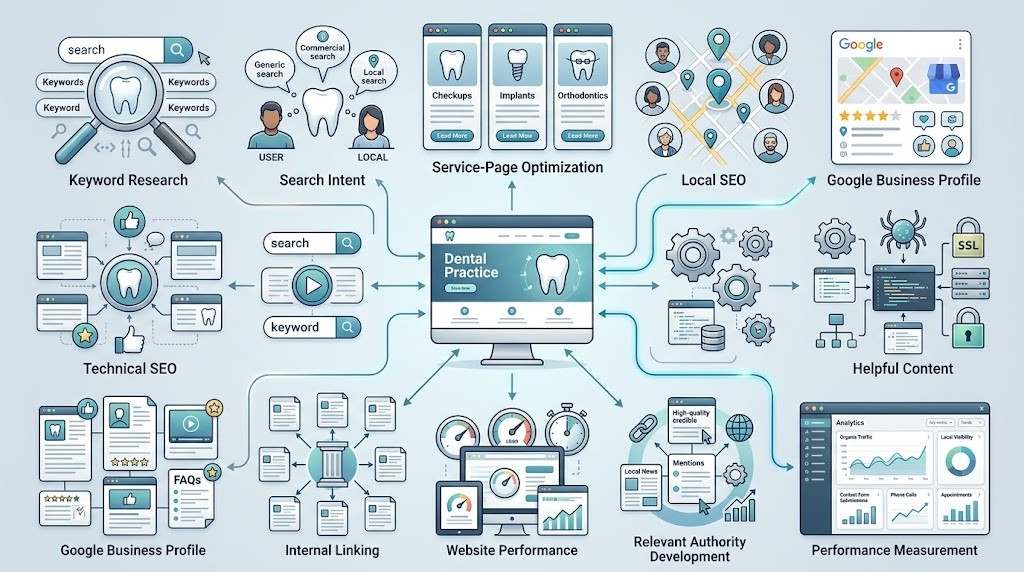
A well-planned strategy can involve technical SEO, service-page optimization, local search, content development, internal linking, website usability, and performance measurement. The goal is not to promise a particular ranking, but to build a website that is useful to both prospective patients and search engines.
This guide explains the main components of dentist SEO, how they work together, common mistakes to avoid, and how dental practices can develop a sustainable search strategy.
What Is Dentist SEO?
Dentist SEO refers to search engine optimization activities designed specifically for dental practices and their audiences.
Unlike a general website that may target a broad geographic or topical audience, a dental practice often serves particular communities and offers specific treatments. Its SEO strategy therefore needs to reflect the services it actually provides, the areas it serves, and the questions potential patients are asking.
A dental SEO strategy may include:
- Keyword research
- Search-intent analysis
- Service-page optimization
- Local SEO
- Technical SEO
- Educational content
- Internal linking
- Website performance improvements
- Online reputation management
- Relevant authority development
- Performance monitoring
For a broader introduction to SEO for dental practices, readers can explore how these different activities can be combined into a structured optimization process.
Why Is SEO Important for Dental Practices?
People use search engines at different stages of the decision-making process.
Someone may search for information about a dental problem, research a treatment, look for a dentist nearby, or compare practices before making an appointment.
Examples include:
- dentist near me
- family dentist in [city]
- emergency dentist in [city]
- dental implants in [city]
- cosmetic dentist in [city]
- pediatric dentist in [city]
- how often should I visit a dentist?
These searches have different levels of intent.
A person looking for general information may not be ready to book an appointment. Someone searching for an emergency dentist nearby may have a much more immediate need.
A useful SEO strategy considers these differences rather than treating every search as if it had the same purpose.
Understanding Search Intent
Search intent describes what a person is trying to accomplish when they perform a search.
Informational Intent
These searches are generally focused on learning.
Examples include:
- What causes tooth sensitivity?
- How does a dental crown work?
- What happens during a dental examination?
Helpful educational content may be appropriate for these searches.
Service Intent
These searches indicate interest in a specific dental service.
Examples include:
- dental implants
- teeth whitening
- root canal treatment
- cosmetic dentistry
Dedicated service pages may be appropriate when the practice genuinely offers those services.
Local Intent
Local searches include geographic signals or imply a nearby provider.
Examples include:
- dentist in [city]
- dentist near me
- emergency dentist [city]
These searches make accurate local business information especially important.
Commercial Investigation
Some people are comparing options before deciding.
They may search for:
- best questions to ask a dentist
- dental implant providers
- cosmetic dentist reviews
- dental practice services
Content should help people make informed decisions rather than simply pushing them toward a conversion.
Build Useful Dental Service Pages
A dental practice should have clear pages for the important services it actually provides.
Depending on the practice, these may include:
- General dentistry
- Dental examinations
- Teeth cleaning
- Dental fillings
- Dental crowns
- Root canal treatment
- Dental implants
- Emergency dentistry
- Cosmetic dentistry
- Pediatric dentistry
A useful service page should do more than repeat the treatment name.
It can explain:
- What the service involves
- Why patients may seek it
- What the appointment may involve
- Important questions patients may want to ask
- General preparation or aftercare information
- When to contact the practice
The exact content should depend on the service and the audience.
Creating a separate page for every minor variation is not automatically beneficial. Each page should exist because it provides useful information or serves a genuine user need.
Optimize Titles, Headings, and Page Content
On-page SEO helps communicate the purpose and subject of each page.
Important elements include:
- Page titles
- H1 and other headings
- Meta descriptions
- URL structure
- Main page content
- Internal links
- Image descriptions
- Clear calls to action
Titles should accurately describe the page rather than simply stacking keywords.
For example, a page about dental implants should make it immediately clear that the page discusses dental implants and, where relevant, the practice providing the service.
Headings should organize information logically so readers can scan the page and find what they need.
Local SEO for Dental Practices
Local SEO can be especially important for dental practices because many patients prefer providers that are convenient to reach.
A practice should make important business information easy to find, including:
- Practice name
- Address
- Phone number
- Opening hours
- Website
- Services
- Appointment information
The website should also communicate its genuine service area clearly.
Avoid creating large numbers of nearly identical pages for locations where the practice has no meaningful presence. Location content should exist to help users, not simply to target additional geographic keywords.
Google Business Profile and Reviews
A dental practice should keep its Google Business Profile information accurate and up to date.
Relevant information may include:
- Business name
- Address
- Phone number
- Hours
- Website
- Services
- Photos
Reviews can also influence how a local business is perceived by prospective customers.
Practices should follow Google’s review guidelines when requesting, responding to, and managing customer reviews.
Reviews should represent genuine experiences. Practices should not attempt to create artificial reviews or manipulate ratings.
Create Helpful Dental Content
A strong dental website should answer questions rather than exist solely as a collection of promotional pages.
Useful content may cover:
- Common dental questions
- Treatment explanations
- Preventive care
- Oral-health education
- Appointment preparation
- Treatment considerations
- Emergency dental questions
- Frequently asked questions
Content should be:
- Accurate
- Original
- Useful
- Easy to understand
- Relevant to the audience
- Appropriate for the practice
Dental information should be presented responsibly. General educational content should not be framed as individualized diagnosis or treatment advice.
Demonstrate Experience and Trust
People considering dental care may want to understand who provides the services and what the practice offers.
A trustworthy website can clearly provide information about:
- Dentists and practitioners
- Professional qualifications
- Areas of practice
- Experience
- Services
- Clinic facilities
- Contact information
This information should be accurate and updated when circumstances change.
Avoid unsupported claims such as being “the best dentist” or guaranteeing particular treatment outcomes.
The purpose of this information is to help visitors understand the practice and make informed decisions.
Technical SEO for Dental Websites
Technical SEO provides the foundation that allows a website to be crawled, understood, and used effectively.
Important areas can include:
- Mobile usability
- Website speed
- Crawlability
- Indexing
- HTTPS
- Broken links
- Redirects
- Site architecture
- Image optimization
Website owners can use Google’s website performance check resource to identify potential performance issues.
However, website speed is only one part of overall website quality. A fast website can still provide a poor experience if its navigation is confusing, content is difficult to read, or important information is hard to find.
Make the Website Mobile-Friendly
Dental patients may search from smartphones while looking for a nearby practice or trying to contact a clinic.
A mobile-friendly website should make it easy to:
- Read content
- Navigate menus
- Tap buttons
- Complete forms
- Find phone numbers
- View opening hours
- Access directions
Important information should not require excessive scrolling or complicated navigation.
Mobile usability should be considered throughout website design and maintenance.
Build a Logical Dental Website Structure
A clear website architecture helps visitors understand how information is organized.
A basic structure might look like:
Homepage
↓
Dental Services
↓
Individual Service Pages
Additional sections could include:
About
Locations
Patient Resources
Contact
Larger practices may require more complex structures, particularly when they have multiple locations or many services.
The key principle is to organize information according to user needs rather than creating pages simply to increase the number of URLs.
Use Internal Linking Strategically
Internal links connect related pages and help readers move between broader and more specific information.
For a dental SEO website, the main Dentist SEO guide can act as a broad resource while supporting pages explore individual areas in greater detail.
For example, practices looking for outside expertise can learn about specialized SEO support for dental practices and the types of work an SEO agency may provide.
SEO can also support a broader marketing strategy. Readers interested in search-focused dental marketing can explore how organic search fits into wider digital marketing activities.
When comparing providers, practices may benefit from understanding what to consider when selecting a dental SEO provider, including communication, reporting, experience, and transparency.
Pediatric dentistry may require a more specialized approach because parents and guardians are often the primary search audience. A dedicated resource on SEO for pediatric dental practices can explore this area in greater detail.
Supporting articles should also link back to this broader Dentist SEO guide when discussing concepts that apply across the wider topic.
The goal of internal linking should always be to help users discover relevant information naturally.
Optimize Dental Website Images
Images can make a dental website more informative and visually engaging.
Common image types include:
- Dental practice photographs
- Dentist portraits
- Clinic interiors
- Educational diagrams
- Treatment-related illustrations
- Infographics
Images should be relevant to the surrounding content.
Useful image practices include:
- Descriptive file names
- Appropriate image dimensions
- Efficient file formats
- Compression where appropriate
- Meaningful alt text
Alt text should describe the image when doing so helps users understand its purpose.
It should not be turned into a list of repeated SEO keywords.
Develop Relevant Authority
External references can contribute to a website’s broader online presence, but quality and relevance matter more than simply accumulating links.
Potential opportunities for a dental practice may include:
- Professional organizations
- Local community organizations
- Relevant publications
- Industry resources
- Genuine partnerships
- Local business directories
The focus should be on legitimate relationships and useful contributions.
Avoid manipulative link schemes, irrelevant mass links, or tactics designed solely to influence rankings.
Dentist SEO and Content Clusters
A well-organized content structure can help a website cover a subject from both broad and specialized perspectives.
For example, a dental SEO content cluster can contain:
Pillar:
Dentist SEO
Supporting topics:
- Dentist SEO Services
- Dentist SEO Agency
- Dentist SEO Marketing
- Dentist SEO Company
- Pediatric Dentist SEO Company
The pillar provides the broad overview.
Supporting articles can then address narrower questions in greater depth and link back to the pillar where relevant.
This structure is useful because readers can move from a general explanation to a more specific resource without having to search for related information elsewhere.
How to Build a Dentist SEO Strategy
A practical SEO strategy can be developed through a series of connected steps.
1. Understand the Dental Practice
Identify:
- Services
- Locations
- Target audience
- Practitioners
- Business goals
- Existing online presence
2. Research Relevant Search Topics
Study searches related to:
- Dental services
- Treatments
- Common questions
- Local needs
- Patient concerns
3. Map Search Intent
Determine whether a topic requires:
- An informational article
- A service page
- A location page
- A comparison resource
- Another type of useful content
4. Review the Website Structure
Check whether important services and information are easy to discover.
5. Improve Existing Pages
Review:
- Titles
- Headings
- Content
- Images
- Internal links
- Navigation
- Contact information
6. Address Technical Issues
Look for:
- Indexing problems
- Broken links
- Mobile usability problems
- Slow pages
- Poor architecture
- Duplicate or unnecessary pages
7. Improve Local Visibility
Maintain accurate business information and provide useful local context.
8. Publish Helpful Content
Create resources that answer real questions and support the services and audience of the practice.
9. Develop Relevant Authority
Pursue legitimate opportunities for relevant mentions and relationships.
10. Monitor and Refine
Review performance over time and improve the strategy based on meaningful data and business objectives.
Professional SEO Support vs. In-House SEO
A dental practice can manage SEO internally or work with an external provider.
An internal approach may provide direct control over content and website changes, but it can also require significant time and specialist knowledge.
Professional support may provide expertise in areas such as:
- Technical SEO
- Keyword research
- Content strategy
- Local SEO
- Website optimization
- Reporting
Neither approach is automatically right for every practice.
The decision should depend on available resources, internal knowledge, business goals, and the complexity of the website.
How to Choose a Dental SEO Provider
Dental practices considering SEO assistance should evaluate providers carefully.
Useful questions include:
- Does the provider understand dental search?
- Is the SEO process clearly explained?
- Are deliverables documented?
- Is reporting transparent?
- How is content created?
- How are technical issues handled?
- How is local SEO approached?
- Are link-building practices explained?
- Are expectations realistic?
Be cautious of providers that promise guaranteed rankings, instant results, or unusually large numbers of backlinks without explaining their relevance or quality.
A good provider should be able to explain what it plans to do and why those activities are appropriate for the practice.
Dentist SEO for Different Types of Practices
SEO strategies can vary depending on the type of dental practice.
General Dentistry
A general dental practice may focus on broad service searches, local visibility, preventive-care information, and patient education.
Cosmetic Dentistry
Cosmetic practices may need detailed treatment pages and educational content addressing procedures and patient questions.
Emergency Dentistry
Emergency dental practices may need strong local visibility and clear information for people searching with immediate needs.
Pediatric Dentistry
Pediatric practices may need content that speaks primarily to parents and guardians.
This specialized area can include topics around children’s dental visits, preventive care, age-specific services, and parent-focused questions.
Common Dentist SEO Mistakes
Keyword Stuffing
Repeating the same phrase excessively can make content unnatural and difficult to read.
Thin Service Pages
Pages containing only a few generic sentences may fail to answer the questions visitors actually have.
Duplicate Location Pages
Creating nearly identical pages for many locations without meaningful local information can reduce the usefulness of the site.
Fake Reviews
Artificial reviews can damage trust and may violate platform policies.
Low-Quality Link Building
Large numbers of irrelevant or manipulative links are not a substitute for genuine authority.
Unrelated Content
Publishing content unrelated to the practice simply because a topic has search volume can weaken the site’s overall focus.
Ignoring Technical Problems
A website can have strong content but still provide a poor experience if important technical issues remain unresolved.
Expecting Instant Results
SEO is generally an ongoing process rather than an instant marketing tactic.
How Long Does Dentist SEO Take?
There is no universal SEO timeline.
Progress can depend on:
- Website history
- Competition
- Geographic market
- Existing authority
- Technical condition
- Content quality
- Search demand
- Consistency
Some improvements may become visible relatively quickly, while broader organic growth can require sustained work.
A responsible SEO strategy should avoid promises such as guaranteed first-page rankings within a fixed number of days.
How Much Does Dentist SEO Cost?
The cost of SEO support varies considerably.
Factors can include:
- Website size
- Number of services
- Competition
- Geographic market
- Content requirements
- Technical complexity
- Local SEO needs
- Reporting requirements
- Scope of ongoing work
There is no single price that is appropriate for every dental practice.
When comparing providers, practices should evaluate the scope and quality of the work rather than selecting an SEO service solely because it has the lowest price.
Measuring Dentist SEO Performance
SEO performance should be evaluated using multiple relevant signals.
Potential measurements include:
- Organic search traffic
- Search impressions
- Click-through rates
- Search queries
- Landing-page performance
- Local visibility
- Phone calls
- Appointment inquiries
- Relevant conversions
Rankings can provide useful context, but they should not be treated as the only measure of success.
Similarly, traffic increases do not automatically mean that the traffic is relevant or valuable to the business.
The most useful measurement framework connects search visibility with the actual goals of the dental practice.
Frequently Asked Questions
What is dentist SEO?
Dentist SEO is the process of improving a dental practice’s website and online presence so relevant dental searches can more easily discover useful information about the practice and its services.
What do dental SEO services include?
They may include keyword research, search-intent analysis, on-page optimization, local SEO, technical SEO, content development, internal linking, authority development, and performance monitoring.
Is SEO important for dentists?
SEO can help dental practices improve their visibility when people search for dental services, information, and local providers.
How long does dentist SEO take?
There is no fixed timeline. Results depend on factors such as competition, website history, technical condition, content, authority, location, and consistency.
Can a dental practice do SEO itself?
Yes. Some practices can manage basic SEO internally. More complex technical, strategic, content, or local SEO work may require additional expertise and resources.
Should every dental service have its own page?
Not necessarily. A service should have its own page when there is enough useful information to justify a dedicated resource and the practice genuinely provides that service.
Does dentist SEO guarantee rankings?
No ethical SEO strategy can guarantee a specific ranking position. Search results are influenced by many factors outside the direct control of an SEO provider.
What is the difference between dental SEO and dental marketing?
Dental SEO focuses primarily on organic search visibility. Dental marketing is broader and can include SEO alongside advertising, social media, email marketing, branding, and reputation management.
Final Thoughts
Dentist SEO is best understood as an ongoing process rather than a single optimization task.
A strong strategy can combine useful service pages, search-intent research, local SEO, technical improvements, helpful content, internal linking, relevant authority development, and performance measurement.
The objective should not be to manipulate search engines or chase rankings at any cost.
Instead, dental practices should build websites that clearly communicate their services, provide useful information, make local business details easy to find, and give prospective patients a better online experience.
When these elements work together, SEO becomes part of a broader digital foundation that can support a dental practice’s long-term search visibility.


