

Publishing an article is not necessarily the end of the content process.
A page that was useful a year ago may now contain outdated information, weak internal links, unclear headings, unnecessary repetition, or sections that no longer match what readers are looking for. In other cases, the information may still be good, but the page structure makes it difficult to find.
This is where SEO editing becomes valuable.
SEO editing is the process of reviewing and improving existing website content so it is clearer, more useful, more accurate, easier to navigate, and better aligned with the intent behind relevant searches.
It is not simply about adding a keyword to an article.
A thoughtful SEO editing process considers search intent, topical relevance, content quality, structure, readability, keyword usage, internal linking, metadata, and factual accuracy while keeping the reader’s needs at the center.
The objective is simple: improve the content that already exists rather than optimizing it for search engines at the expense of the people reading it.
What Is SEO Editing?
SEO editing is the process of evaluating and improving existing content with both editorial quality and search relevance in mind.
An SEO editor examines the complete page rather than focusing on individual keywords. They look at what the page is trying to accomplish, who it is intended for, and whether it actually answers the questions a visitor is likely to have.
An SEO editing review may include:
- evaluating search intent
- improving headings and content hierarchy
- refining keyword usage
- removing unnecessary repetition
- improving readability
- filling important content gaps
- updating outdated information
- reviewing internal links
- improving title tags and meta descriptions
- checking factual accuracy
- strengthening topical relevance
The important point is that optimization should follow usefulness.
For example, if an article about SEO editing already explains the subject clearly, adding the exact phrase “SEO editing” to every paragraph would not improve it. It would make the writing repetitive and potentially less pleasant to read.
SEO editing is also different from several related editorial activities.
| Process | Primary purpose |
| SEO editing | Improve existing content for usefulness, relevance, structure, and search considerations |
| Copy editing | Improve wording, consistency, clarity, and style |
| Proofreading | Find spelling, grammar, punctuation, and formatting errors |
| Content rewriting | Substantially change or recreate existing content |
These processes can overlap. An article may need SEO editing first, followed by copy editing and a final proofreading pass.
Why Is SEO Editing Important?
Web content does not remain static.
Information changes. Products and services are updated. Links become broken. Search behavior evolves. Websites publish new pages that create better internal-linking opportunities. Even an article that was carefully written can develop weaknesses over time.
SEO editing provides a structured way to identify those weaknesses.
An editorial review may uncover:
- outdated information
- weak or incomplete sections
- search-intent mismatches
- vague headings
- a weak introduction
- excessive keyword repetition
- missing internal links
- broken references
- poor organization
- unsupported claims
- unnecessary sections
The goal is not to change content simply because it is old. The goal is to determine whether the page still does its job well.
A useful question is:
If someone arrived at this page today, would it give them a clear and satisfying answer to what they came to learn?
That question keeps SEO editing focused on people rather than optimization for its own sake.
Google’s current guidance similarly emphasizes helpful, reliable, people-first content and encourages creators to assess whether their pages provide substantial, original, trustworthy value rather than merely being produced to attract search traffic.
SEO Editing vs Traditional Editing
Traditional editing and SEO editing share many principles. Both value clear writing, logical structure, accuracy, and a good reading experience.
The difference is that SEO editing adds a search-focused layer.
| Area | Traditional Editing | SEO Editing |
| Main goal | Improve writing quality | Improve writing quality and search relevance |
| Search intent | Usually secondary | Core consideration |
| Keywords | May not be reviewed | Reviewed for natural relevance |
| Headings | Checked for clarity | Checked for clarity, hierarchy, and topic alignment |
| Internal links | May be incidental | Reviewed for relevance and navigation |
| Metadata | Often outside the process | Title, description, and URL reviewed |
| Readability | Important | Important |
| Search relevance | Limited focus | Explicitly considered |
| User experience | Important | Central priority |
Good SEO editing does not sacrifice editorial quality for optimization.
Instead, it combines the two.
A page should be easy to understand before it is optimized to be easier for search engines to interpret.
How to Review Search Intent Before Editing
Before changing an article, determine what the searcher actually wants.
Search intent is the reason behind a query. Understanding it helps an editor decide whether the existing article is answering the right question.
Informational intent
The searcher wants to learn.
Examples include:
- What is SEO editing?
- How does SEO editing work?
- How do I optimize existing content?
These searches generally require explanations, examples, definitions, and practical guidance.
Commercial investigation
The searcher is researching possible solutions before making a decision.
Examples include:
- best SEO editing service
- SEO editor for website content
- professional SEO content editing
Content targeting this intent may need to explain options, processes, evaluation criteria, and what a service actually involves.
Transactional intent
The searcher is ready to take an action, such as purchasing a service or contacting a provider.
The page should make the next step clear without turning every section into a sales pitch.
Navigational intent
The searcher is trying to reach a particular website, brand, or page.
The content requirements for this type of query are different from those of a broad educational guide.
The key principle is simple:
Do not edit an article to match a keyword while ignoring the reason someone searched for that keyword.
A page can mention the right phrase and still fail because it answers the wrong question.
How to Edit Keywords Naturally
Keywords can help clarify a page’s subject, but they should never dictate every sentence.
Start with the main topic and then consider related terms that naturally belong to the subject.
For SEO editing, related terminology may include:
- SEO content editing
- search-focused editing
- content optimization
- SEO editor
- editing content for SEO
- optimizing existing content
- SEO content optimization
The primary topic may naturally appear in:
- the title
- H1
- introduction
- relevant H2s
- body content
- image ALT text when appropriate
- meta description
However, exact-match repetition is not the objective.
Consider these two approaches:
Unnatural:
SEO editing helps with SEO editing because SEO editing improves SEO content through SEO editing.
Natural:
A structured editorial review can improve a page’s clarity, organization, relevance, and usefulness while preserving its original purpose.
The second version communicates the concept without forcing a keyword into every sentence.
Avoid:
- keyword stuffing
- repetitive exact-match phrases
- awkward keyword placement
- changing natural wording solely to insert a keyword
- using related terms that do not actually fit the topic
Google’s Search Essentials recommends using the words people would use to look for your content and placing them in appropriate, descriptive locations, while its broader guidance emphasizes people-first content.
Improving Headings During SEO Editing
Headings provide the structure readers use to navigate a page.
An SEO editor should review the H1, H2s, and H3s to make sure the hierarchy is logical and that each heading accurately describes the section beneath it.
For example:
H1: SEO Editing: A Practical Guide to Optimizing Content for Search
H2: What Is SEO Editing?
H2: How to Review Search Intent Before Editing
H3: Informational Intent
H3: Commercial Investigation
This hierarchy makes the relationship between the sections clear.
Compare:
Weak heading:
Important Things
More useful heading:
How to Update Outdated Information
The second heading gives the reader an immediate reason to continue.
Good headings should be:
- descriptive
- concise
- logically organized
- relevant to the content underneath
- aligned with reader expectations
Do not turn headings into collections of keyword variations. A useful heading should help a person understand the page, not merely signal that a keyword exists.
Improving Content Structure
Strong information can still perform poorly as a user experience if it is presented in the wrong order.
During SEO editing, review the complete structure of the article.
Introduction
The introduction should quickly establish the subject, explain why it matters, and tell the reader what they can expect.
Avoid taking several paragraphs to reach the main point.
Section order
Move foundational information before more advanced concepts.
For example, define SEO editing before explaining how to build an SEO editing workflow.
Paragraphs
Keep individual paragraphs focused on one main idea where possible.
Large blocks of text can make web content difficult to scan.
Lists
Use bullet points when several related ideas can be presented more clearly as a group.
Tables
Tables are useful when readers need to compare concepts, processes, or options.
Examples
Examples can turn an abstract editorial principle into something readers can immediately understand.
FAQs
FAQs can address genuine questions that remain after the main article has answered its central topic. They should not be added simply to repeat keywords.
Conclusion
A useful conclusion should reinforce the central lesson and leave the reader with a clear understanding of what to do next.
A good information hierarchy allows readers to move from question → explanation → practical application without unnecessary friction.
SEO Editing for Readability
Readability is an important part of useful content.
An editor should look for unnecessarily complicated sentences, repetitive explanations, unclear transitions, and terminology that has not been explained.
Useful improvements include:
- writing clearer sentences
- shortening unnecessarily long paragraphs
- using active voice where appropriate
- removing repetition
- explaining technical terms
- adding practical examples
- improving transitions between sections
For example:
Before:
The implementation of optimization methodologies should subsequently facilitate the improvement of the content’s search-oriented relevance.
After:
Optimization should make the content more relevant to what people are searching for.
The second sentence is easier to understand and communicates the same basic idea.
Technical subjects do not need unnecessarily complicated language.
The purpose of editing is to make useful information easier to understand, not to make the writing sound more sophisticated.
Updating Outdated Content
One of the most practical uses of SEO editing is reviewing older content.
Look for:
- outdated statistics
- old recommendations
- broken links
- outdated screenshots
- discontinued products or services
- obsolete terminology
- expired references
- changes in search practices
However, updating content should always involve verification.
If an old statistic can no longer be confirmed through a reliable source, do not simply replace it with another number because it looks newer.
It may be better to remove the statistic or rewrite the statement in a way that does not depend on an unsupported figure.
Likewise, changing a publication date without meaningfully improving the content does not turn an old article into a genuinely updated resource.
The purpose of an update should be to make the page more accurate and useful.
Internal Linking During SEO Editing
Internal linking is another area that is easy to overlook during content updates.
A useful internal link should help the reader discover related information or move naturally to the next relevant topic.
When reviewing internal links, consider:
- relevance
- descriptive anchor text
- context
- navigation
- relationships between related pages
- link quantity
- orphaned content
For example, when an article reaches the final editorial-quality stage, a reader may benefit from a more detailed guide covering SEO proofreading techniques.
The important point is context.
Internal links should not be added simply because another page needs a link. They should exist because the destination provides useful additional information.
An editor should also look for pages that have useful content but receive few or no relevant internal links. Connecting related articles can make a site’s information architecture easier for both readers and search engines to understand.
SEO Metadata Editing
SEO editing should not stop at the article body.
Review the:
- title tag
- meta description
- URL structure
The title should accurately describe the page and make its subject clear.
The meta description should provide a useful summary of what the page contains. It should not make promises that the article cannot support.
The URL should also be concise, understandable, and consistent with the site’s structure.
Metadata is part of how the page is presented in search, but it should always accurately represent the underlying content.
A strong title or description can help users understand what a result offers, but neither should be treated as a guarantee of higher rankings.
Content Quality Checks
Before an edited article is published, review its overall quality.
Ask:
- Is the information accurate?
- Is the content original?
- Does it cover the subject adequately?
- Are important claims supported?
- Are explanations specific enough to be useful?
- Does the content demonstrate appropriate expertise?
- Is first-hand experience included where relevant?
- Would a reader understand what to do after reading it?
- Does the page provide value beyond simply repeating common information?
Google’s people-first guidance specifically encourages creators to consider whether content provides original information or analysis, offers substantial coverage, avoids simply copying or rewriting other sources, and gives readers a satisfying experience.
For that reason, an SEO editor should not treat originality as a synonym for changing words.
A page can be technically rewritten while still providing little additional value.
The stronger approach is to improve the explanation, add useful context, clarify difficult concepts, provide practical examples, and make the content genuinely more useful.
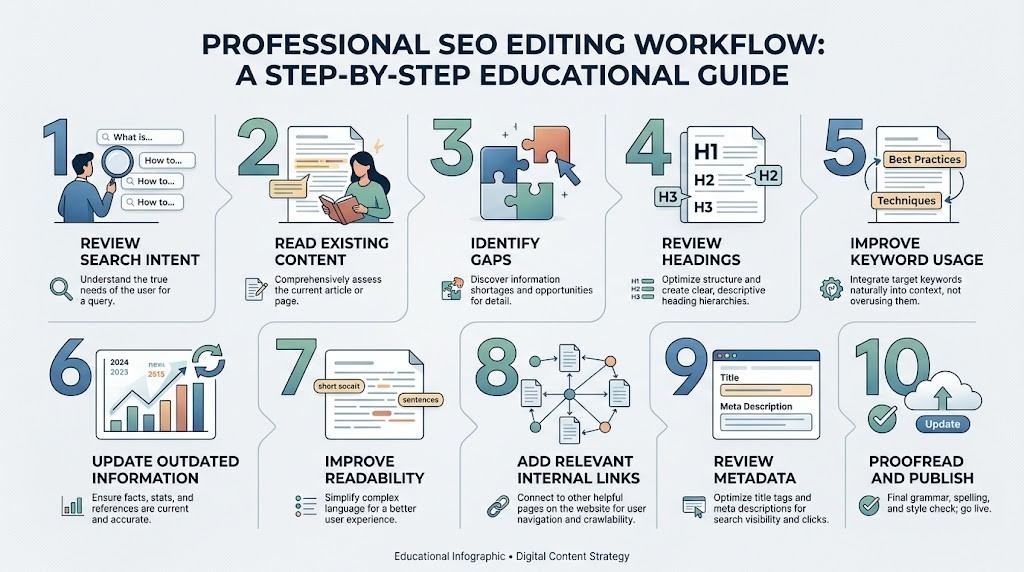
SEO Editing Workflow
A repeatable process makes content optimization more consistent.
1. Review the target query
Understand the primary subject and the language people may use when searching for it.
2. Understand search intent
Determine what the searcher is actually trying to accomplish.
3. Read the entire article
Understand the article before making sentence-level changes.
4. Identify weak or outdated sections
Mark content that is repetitive, incomplete, inaccurate, irrelevant, or unclear.
5. Review headings
Check the H1, H2s, and H3s for logical hierarchy.
6. Review keyword usage
Make sure the primary topic and related concepts appear naturally.
7. Improve the structure
Reorder sections when the existing sequence does not follow the reader’s journey.
8. Improve readability
Simplify complicated sentences and remove unnecessary repetition.
9. Add relevant internal links
Connect the page to genuinely useful related content.
10. Review metadata
Check the title, meta description, and URL.
11. Check factual accuracy
Verify important claims, references, statistics, and recommendations.
12. Proofread the final version
Check grammar, spelling, punctuation, formatting, and consistency.
13. Re-read it from the searcher’s perspective
Ask whether the final page actually satisfies the need behind the search.
For websites with larger content libraries, this process can be organized into a broader content optimization workflow so pages are reviewed systematically rather than updated randomly.
When Should You Hire an SEO Editor?
Not every website needs a dedicated SEO editor.
For a small site with a limited number of pages, the owner or writer may be able to perform a structured review themselves.
Professional support can become useful when a website has:
- a large existing content library
- declining organic performance
- many outdated articles
- content that receives impressions but does not adequately satisfy users
- multiple writers
- inconsistent editorial standards
- a need for systematic content optimization
An experienced SEO content editor should not apply the same changes to every article.
Different pages have different audiences, purposes, and search intents.
The value of professional editing comes from making appropriate decisions for each page while maintaining consistent quality across the site.
SEO Editing Tools and Data
SEO editors can use tools to understand how existing pages perform and where improvement opportunities may exist.
Useful data can include:
- search queries
- impressions
- clicks
- click-through rate
- average position
- page performance
- content structure
- broken links
- internal-link relationships
- readability
Google Search Console can provide organic search data that helps editors understand which queries and pages are appearing in Google Search and how users interact with those results.
For example, a page may receive impressions for several related queries that are not adequately addressed in the article. That can provide a useful signal for reviewing the content.
Likewise, a page with strong impressions but a comparatively low CTR may deserve a review of its title, description, or alignment with the queries for which it appears. Google specifically notes that the Performance report can be used to identify low-CTR pages and evaluate whether titles, descriptions, or content should better match user queries.
Tools should support editorial judgment rather than replace it.
Data can show where to investigate. It does not automatically tell an editor what the correct editorial decision is.
SEO Editing for International Content
Content aimed at different countries or audiences needs additional editorial attention.
A direct translation can preserve individual words while losing the meaning or context that matters to local readers.
Review:
- search intent
- terminology
- language
- spelling
- local context
- cultural references
- regional search behavior
A phrase that sounds natural in one market may be unusual in another.
The same applies to examples, measurements, product terminology, and expectations.
International SEO editing therefore involves more than translating keywords.
The goal is to make the content genuinely useful for the intended audience. For broader international projects, search-focused content improvements may need to account for regional language, terminology, and search behavior while preserving the original purpose of the page.
Common SEO Editing Mistakes
Even well-intentioned optimization can make content worse.
Adding keywords everywhere
More keyword repetitions do not automatically make an article more relevant.
Changing content without understanding search intent
A page can target the right phrase while still answering the wrong question.
Removing useful information
Editing should not mean making an article shorter at any cost. Remove unnecessary material, but preserve information that genuinely helps readers.
Making content too generic
Replacing specific explanations with vague SEO language reduces usefulness.
Copying competitor wording
Competitor research can reveal topics worth considering, but copying their wording does not create original value.
Ignoring factual accuracy
An optimized article containing incorrect information is still a poor resource.
Over-optimizing headings
Headings should help readers navigate the page, not become collections of keywords.
Adding irrelevant internal links
Every link should have a clear contextual purpose.
Updating information without checking sources
A newer claim is not automatically a better claim.
Focusing only on rankings
Search visibility matters, but the page ultimately exists to serve people.
Google’s current guidance recommends creating content primarily to help people rather than producing search-engine-first material designed mainly to attract search traffic.
SEO Editing Checklist
Before publishing an edited page, check:
- Search intent has been reviewed
- The primary topic is clear
- The H1 accurately describes the page
- H2s and H3s follow a logical hierarchy
- Keywords are used naturally
- Important information is accurate
- Outdated information has been checked
- Internal links are relevant
- Metadata has been reviewed
- Images have appropriate ALT text where needed
- Paragraphs are easy to scan
- Technical terms are explained
- Repetition has been removed
- Examples genuinely help the reader
- Important claims have been verified
- Final proofreading is complete
- The finished page satisfies the searcher’s underlying need
The final quality-control question should be:
If I arrived here from Google without knowing anything about this topic, would I feel that my question had been properly answered?
If the answer is yes, the editing process is doing its job.
Frequently Asked Questions
What is SEO editing?
SEO editing is the process of reviewing and improving existing website content for search intent, relevance, structure, readability, accuracy, internal linking, metadata, and overall usefulness.
How is SEO editing different from proofreading?
Proofreading primarily looks for spelling, grammar, punctuation, formatting, and similar errors. SEO editing has a broader scope and also examines search intent, content structure, keyword usage, topical relevance, internal links, and metadata.
Why is SEO editing important?
SEO editing can identify weaknesses in existing content, including outdated information, unclear structure, poor readability, missing information, unnatural keyword usage, and weak internal linking.
Does SEO editing improve rankings?
SEO editing can improve aspects of a page that may support its search performance, but it cannot guarantee rankings. Search visibility depends on many factors, and changes may take time to be reflected in search results.
How often should old content be edited?
There is no universal schedule. Review content when information changes, the page becomes outdated, performance changes, or the content no longer satisfies its intended audience effectively.
What does an SEO editor do?
An SEO editor evaluates existing content for search intent, relevance, structure, readability, keyword usage, accuracy, internal links, metadata, and overall usefulness.
Can I edit SEO content myself?
Yes. Website owners and writers can use a structured SEO editing process themselves. Larger content libraries may benefit from a consistent editorial workflow or professional support.
What should I check before publishing edited content?
Review search intent, headings, keyword usage, factual accuracy, outdated information, internal links, metadata, readability, images, formatting, and final proofreading.
Final Thoughts
SEO editing is best understood as content improvement with search considerations, not as keyword insertion.
The strongest edits make an existing page easier to understand, more accurate, better organized, more complete, and more useful to the people who need it.
Start with the searcher’s question.
Understand the intent. Read the entire page. Identify weaknesses. Improve the structure. Refine the language. Update information carefully. Strengthen useful internal connections. Review the metadata. Verify important claims. Then proofread the finished version.
Most importantly, do not edit content simply because you think a search engine wants more words or more keywords.
Edit it because the reader deserves a better page.
When this approach is applied consistently, SEO editing can become an important part of maintaining a high-quality content library and building a stronger foundation for an SEO-focused website.


