

Creating website content is only part of the job. Content also needs to be clear, useful, accurate, well organized, and aligned with what people are actually looking for. This is where an SEO editor can play an important role.
An SEO editor combines traditional editorial judgment with search-focused content review. Instead of simply correcting grammar or adding keywords, they examine whether a page answers the right questions, follows a logical structure, uses relevant terminology naturally, and provides a useful experience for readers.
Good SEO editing is not about making a page sound as though it was written for a search engine. It is about improving the content so that its purpose is clearer to readers and its subject is easier to understand.
For businesses with existing articles, multiple writers, large content libraries, or frequently updated websites, an SEO editor can help bring consistency and focus to the content improvement process.
What Is an SEO Editor?
An SEO editor is a professional who reviews and improves website content from both an editorial and search perspective.
Their work can include evaluating an existing article, identifying content gaps, improving headings, reviewing keyword usage, checking internal links, refining metadata, improving readability, and making sure the content matches the likely search intent behind the topic.
The exact responsibilities vary between organizations. In one company, an SEO editor may work closely with writers and focus almost entirely on content. In another, the role may include reviewing search performance data, updating older pages, and coordinating with SEO specialists.
The main objective is consistent: make website content more useful, understandable, relevant, and well structured without sacrificing the reader’s experience.
An SEO editor may improve content by making it:
- Clearer and easier to understand
- More useful for the intended audience
- Better organized
- More closely aligned with search intent
- Easier to scan and navigate
- More consistent with editorial standards
- More accurate and up to date
The role sits between content quality and search-focused optimization. It does not necessarily include every part of technical SEO, link building, or broader SEO strategy.
What Does an SEO Editor Do?
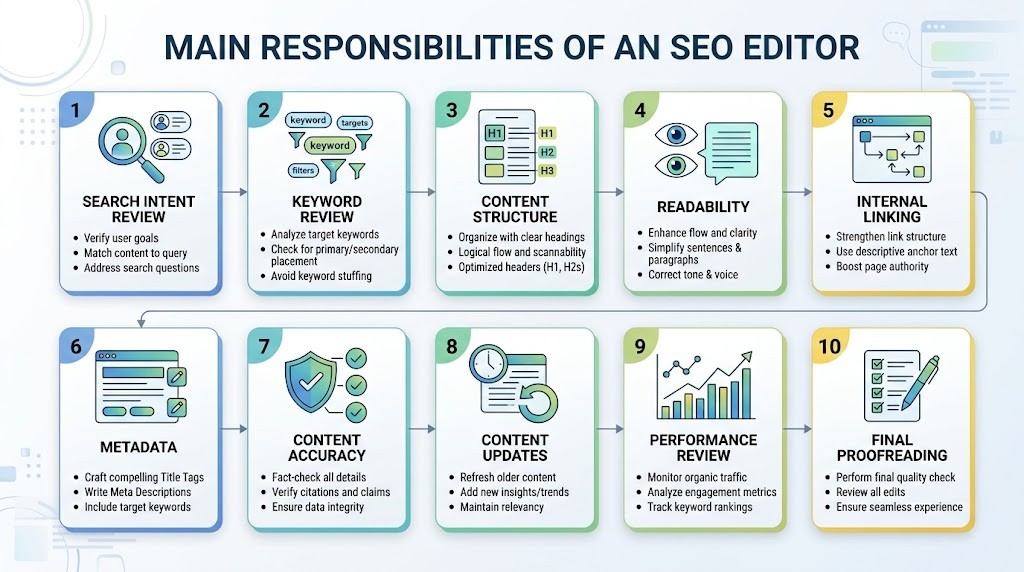
The day-to-day responsibilities of an SEO editor depend on the website and team, but several activities are common.
Reviews Search Intent
Before changing an article, an editor needs to understand what the page is supposed to accomplish. A page targeting an informational query should not suddenly become a sales page simply because a commercial keyword appears in the topic.
Evaluates Existing Content
An SEO editor looks beyond grammar. They may ask whether the introduction is useful, whether important questions are unanswered, whether sections are in the right order, and whether the article provides enough context.
Improves Headings
Headings help readers understand what information is coming next. An editor can make headings more descriptive, remove vague sections, and establish a logical hierarchy.
Reviews Keyword Usage
The editor checks whether the main topic and relevant terminology appear naturally. The goal is not to repeat a phrase as many times as possible.
Improves Readability
Long explanations can often be made clearer through shorter paragraphs, better transitions, simpler wording, examples, lists, or more logical organization.
Checks Internal Links
Internal links should connect related pages and help readers discover useful information. An SEO editor can identify missing opportunities, irrelevant links, poor anchor text, or pages that are difficult to reach.
Reviews Metadata
Titles, meta descriptions, URLs, and image ALT text may be reviewed to ensure they accurately describe the page.
Identifies Content Gaps
An editor may discover that an article discusses a topic generally but fails to answer an important question that the intended audience would reasonably expect.
Checks Factual Accuracy
Content should not be optimized at the expense of accuracy. Claims, dates, examples, definitions, and other factual information should be reviewed appropriately.
Updates Outdated Information
Older pages may contain obsolete terminology, broken references, outdated examples, or information that no longer reflects the current situation.
Maintains Editorial Consistency
When several people contribute to a website, an SEO editor can help maintain consistent terminology, formatting, tone, structure, and content standards.
Not every SEO editor performs every technical SEO task. Technical issues may instead be handled by an SEO specialist, developer, or technical SEO consultant.
SEO Editor vs Content Editor
An SEO editor and a content editor can perform many of the same tasks, but their primary perspectives are different.
| Area | SEO Editor | Content Editor |
|---|---|---|
| Primary focus | Content quality plus search relevance | Content quality and editorial standards |
| Search intent | Usually a major part of the review | May or may not be a major focus |
| Keywords | Reviews relevance and natural usage | May review language without SEO emphasis |
| Content structure | Considers readers and search needs | Primarily considers clarity and flow |
| Editorial quality | Important | Core responsibility |
| Internal links | Often reviews relevance and context | May review links for editorial usefulness |
| Metadata | May review titles and descriptions | Usually less involved |
| Search performance | May use performance data | Usually less involved |
These roles are not rigidly separated. A strong content editor may understand SEO very well, while an SEO editor still needs strong editorial judgment.
The important difference is the depth of search-focused review rather than the job title itself.
SEO Editor vs SEO Content Writer
An SEO content writer and an SEO editor often work together, but their responsibilities usually occur at different stages of the content process.
| Area | SEO Editor | SEO Content Writer |
|---|---|---|
| Main role | Reviews and improves content | Creates and develops content |
| Search intent | Evaluates whether content satisfies intent | Uses intent when planning and writing |
| Structure | Revises and strengthens structure | Builds the initial structure |
| Keywords | Reviews relevance and natural usage | Incorporates relevant terminology |
| Existing content | Often a major responsibility | Usually focuses on new content |
| Editorial review | Core responsibility | Part of the writing process |
| Final quality | Checks content before publication | Produces the initial draft |
The two roles can overlap, particularly in smaller teams. One person may write an article and then edit it from an SEO perspective.
However, separating writing and editorial review can be useful for larger content operations because another person can evaluate the draft more objectively.
SEO Editor vs SEO Proofreader
Editing and proofreading happen at different stages and involve different levels of intervention.
An SEO editor may restructure an article, rewrite an unclear section, change headings, address search intent, identify content gaps, or recommend additional information.
Proofreading is generally more focused on the final quality of the text. A proofreader may identify spelling mistakes, punctuation problems, grammatical errors, inconsistencies, awkward wording, and formatting issues.
For websites where proofreading also considers search-focused concerns, SEO-focused proofreading can complement the broader editing process.
The distinction is useful because a page can be grammatically perfect and still have poor structure or weak search relevance. Conversely, a well-structured SEO article can still require a final proofreading pass before publication.
SEO Editor vs SEO Consultant
An SEO editor primarily works with website content. An SEO consultant generally operates at a broader strategic level.
An editor may review an article and recommend changes to its structure, relevance, readability, links, headings, or metadata. A consultant may assess a site’s broader search strategy, technical SEO, content opportunities, site architecture, competitive landscape, and business objectives.
There can be considerable overlap. An experienced SEO editor may understand technical concepts, while an SEO consultant may have strong editorial skills.
Businesses looking for broader SEO consultant expertise may therefore need a consultant when the problem extends beyond individual pages.
Neither role is universally better. The appropriate choice depends on the problem being solved.
How an SEO Editor Reviews Search Intent
Search intent describes the reason behind a search.
Informational Intent
The user wants to learn something.
For example, a person searching for an explanation of a marketing concept probably wants a useful explanation rather than an immediate sales pitch.
Commercial Investigation
The user is researching options before making a decision. They may want comparisons, features, considerations, pricing factors, or recommendations.
Transactional Intent
The user is prepared to take an action, such as buying, booking, subscribing, requesting a quote, or signing up.
Navigational Intent
The user is trying to reach a particular website, brand, company, or page.
An SEO editor considers whether the existing content actually matches the likely purpose of the search.
For example, if a page is intended to answer a question but spends most of its space promoting a service, the editor may recommend changing the balance. If a commercial investigation page lacks comparisons or decision-making information, it may not adequately serve its audience.
Search intent therefore influences not only keywords but also the content’s depth, format, structure, and purpose.
How an SEO Editor Reviews Keywords
Keyword review should focus on meaning rather than repetition.
An SEO editor may examine:
- The primary topic
- Closely related terms
- Important concepts
- Keyword placement
- Search relevance
- Natural language
- Potential over-optimization
Important terminology can naturally appear in the title, introduction, headings, body copy, image ALT text where appropriate, and metadata.
However, there is no editorial benefit in forcing a phrase into every section.
A useful question is: Would this wording make sense if search engines did not exist?
If the answer is no, the phrase probably needs to be rewritten.
The editor’s goal is to make the subject unmistakable while preserving natural language and reader value.
Improving Content Structure
Structure determines how easily readers can understand and navigate a page.
An SEO editor may review the complete hierarchy, including:
- Introduction
- H1
- H2 headings
- H3 headings
- Paragraphs
- Lists
- Tables
- Examples
- FAQs
- Conclusion
A strong introduction should quickly establish what the page covers and why it matters. The H1 should accurately represent the main topic. H2s should divide the subject into meaningful sections, while H3s can provide additional organization where needed.
Paragraphs should generally focus on one idea at a time. Lists can make multiple points easier to scan, while tables are useful when readers need to compare clearly defined items.
For businesses developing search-friendly content editing processes, structure should be evaluated from the perspective of both the reader and the subject being covered.
Good structure does not mean adding headings simply to increase the number of headings. Every section should have a purpose.
SEO Editing for Readability
Readability is a core part of useful website content.
An SEO editor may improve readability by:
- Using clearer sentences
- Keeping paragraphs manageable
- Removing unnecessary repetition
- Replacing unnecessarily complicated terminology
- Using active voice where it improves clarity
- Adding transitions between ideas
- Explaining unfamiliar concepts
- Providing practical examples
Readability does not mean every sentence must be extremely short. Some subjects require detailed explanations or technical terminology.
The goal is to make the information understandable for the intended audience.
For example, a technical B2B audience may be comfortable with specialist terms that would need explanation in a beginner-focused article. Good editing takes the audience into account rather than applying the same writing formula everywhere.
What Skills Does an SEO Editor Need?
An effective SEO editor needs a combination of editorial, search, analytical, and communication skills.
Editorial Skills
Strong grammar, sentence construction, organization, clarity, and attention to detail are fundamental.
SEO Knowledge
The editor should understand concepts such as search intent, on-page SEO, internal linking, keyword relevance, metadata, and content structure.
Content Analysis
An editor should be able to identify missing information, weak sections, outdated material, unclear explanations, and opportunities to improve usefulness.
Search Performance Analysis
Basic familiarity with search performance data can help an editor understand how existing pages are performing and where further review may be useful.
Communication
SEO editors often work with writers, marketers, SEO specialists, and business owners. They need to explain recommendations clearly rather than simply making unexplained changes.
Industry Knowledge
Experience in a particular industry can be valuable when content involves specialized terminology, regulations, technical concepts, or fact-sensitive information.
The best SEO editor is therefore not simply someone who knows where to place keywords. The role requires editorial judgment combined with a practical understanding of search.
Internal linking should help readers move naturally between related pages.
An SEO editor may review links for:
- Relevance
- Context
- Descriptive anchor text
- User navigation
- Related content
- Topic relationships
- Potential orphaned pages
A link should have a reason to exist. If a reader is learning about one aspect of SEO content and another page provides useful background or a deeper explanation, an internal link can make the overall experience better.
Links should not be added simply to increase the number of links on a page.
For websites serving different countries or languages, content teams may also need international SEO expertise to ensure that content, terminology, and search intent are appropriate for the markets being served.
Metadata and On-Page Elements
An SEO editor may also review important on-page elements.
Title Tags
The title should accurately communicate what the page is about.
Meta Descriptions
The description should summarize the page accurately and give searchers a useful reason to understand what they will find.
URLs
A URL should be understandable and relevant to the page where practical.
Image ALT Text
ALT text should describe an image appropriately when the image conveys meaningful information. It should not be turned into a list of keywords.
Headings
Headings should describe the content beneath them and follow a logical hierarchy.
These elements contribute to how a page is presented and understood, but no individual element guarantees rankings.
What Tools Does an SEO Editor Use?
The tools used by an SEO editor depend on the website, team, and workflow. The important point is not using a particular tool but using the right type of information to make better editorial decisions.
Common tool categories include:
- Search performance tools for queries, impressions, clicks, and CTR
- Keyword research tools for discovering relevant topics and terminology
- Content optimization tools for reviewing topical coverage and on-page elements
- Grammar and readability tools for identifying language issues
- Analytics platforms for understanding user and website behavior
- Content management systems for editing and updating published pages
- Internal-linking tools for discovering relevant pages and potential link opportunities
Google Search Console can be particularly useful when an editor is reviewing content that already receives search impressions because it provides actual search-performance information from the website.
The tools should support editorial judgment rather than replace it.
Content Quality and Search Guidelines
High-quality website content should be helpful, accurate, relevant, understandable, and created primarily for people.
Google’s Search Essentials provide guidance on the technical requirements and key practices that help pages become eligible to appear in Google Search.
Google also provides guidance on creating helpful, reliable, people-first content. These principles are useful editorial checkpoints when reviewing website content.
The question is not simply whether a page contains the target keyword. It is whether the page actually provides useful information and fulfills its intended purpose.
The same people-first principle should influence editorial decisions. Content should not be padded with unnecessary sections simply because a competitor has more words. It should not copy another website’s structure or wording. It should provide information that is useful for the audience.
An SEO editor can therefore use search guidelines as part of a broader quality review rather than treating SEO as a checklist of keyword placements.
Using Search Performance Data
An SEO editor does not have to rely entirely on editorial judgment. Search performance data can provide useful clues about which pages deserve closer review.
Relevant information can include:
- Impressions
- Clicks
- Queries
- Click-through rate
- Pages
- Search trends
Google Search Console allows website owners to examine search performance information and understand how their pages appear in Google Search.
For example, a page may receive substantial impressions but relatively few clicks. That does not automatically mean the page is poor, but it can justify examining the title, description, search intent, and content alignment.
Similarly, unexpected queries can reveal that Google is associating a page with topics that the editor did not initially consider. Those observations may lead to content improvements or new content ideas.
Performance data should be treated as evidence rather than a complete explanation. Search visibility can change for many reasons, and a single metric cannot explain every change.
Updating Existing Content
One of the most valuable uses of an SEO editor is improving content that already exists.
Older pages can be reviewed for:
- Outdated information
- Broken links
- Missing sections
- Changed terminology
- Old examples
- Incorrect claims
- Changes in search intent
An update should have a clear purpose. Simply changing a publication date or rewriting sentences without improving the substance does not necessarily make a page more useful.
Factual information should be verified before it is changed. This is particularly important for topics where information changes frequently.
An editor should also consider whether the original intent of the page is still appropriate. Sometimes the best update is a relatively small revision. In other cases, the page may need substantial restructuring.
SEO Editor vs SEO Content Audit
An SEO content audit and SEO editing are related, but they are not the same process.
A content audit generally evaluates a larger group of pages to identify problems, opportunities, outdated content, weak performance, duplication, or gaps.
SEO editing focuses more directly on improving an individual piece of content or a selected group of pages.
For example, an audit may identify an article that has declining visibility and weak topical coverage. The SEO editor can then review that article in detail and determine what should be rewritten, expanded, removed, reorganized, or internally linked.
This distinction is useful for larger websites because auditing can help determine which pages need attention, while editing determines how those pages should be improved.
How to Create an SEO Editing Workflow
A consistent workflow makes content review easier to manage.
1. Identify the Target Page
Determine which page needs editing and why it has been selected.
2. Understand Its Search Intent
Establish what the audience is likely trying to accomplish.
3. Review the Existing Content
Read the complete page before making changes.
4. Identify Weaknesses and Gaps
Look for missing information, unclear explanations, outdated material, or unnecessary sections.
5. Review Headings
Check whether the hierarchy accurately represents the content.
6. Review Keyword Usage
Confirm that important terminology is relevant and naturally incorporated.
7. Improve Structure
Reorganize sections when doing so makes the information easier to follow.
8. Improve Readability
Remove unnecessary repetition and clarify difficult passages.
9. Review Internal Links
Check whether existing links are relevant and whether useful related content is missing.
10. Review Metadata
Ensure the title, description, URL, and other on-page elements accurately represent the page.
11. Verify Factual Information
Check claims, examples, dates, terminology, and other information that may have changed.
12. Proofread the Final Version
Perform a final language, formatting, consistency, and quality check.
13. Publish or Update
Make the revised page available once the editorial review is complete.
14. Monitor Performance
Review relevant performance information over time and use observations to inform future improvements.
This workflow creates a repeatable process without treating SEO editing as a one-time keyword exercise.
When Does a Business Need an SEO Editor?
A dedicated SEO editor can be useful when a website’s content operation becomes difficult to manage consistently.
Common situations include:
- Large content libraries
- Multiple writers
- Frequent publishing
- Existing content that needs improvement
- Declining content performance
- Inconsistent editorial quality
- Regular content updates
- Scaling content production
However, not every business needs a full-time SEO editor.
A small website may be able to manage content review through an existing writer, content editor, SEO specialist, freelancer, or marketing team member.
The need usually becomes clearer when content volume increases or when businesses discover that publishing more articles is not solving their content-quality problems.
How Much Does an SEO Editor Cost?
The cost of hiring an SEO editor varies considerably because editing requirements differ from one website to another.
Pricing may depend on:
- Number of words or pages
- Complexity of the subject
- Amount of existing content
- Whether keyword research is included
- Whether content strategy is included
- Industry expertise
- One-time or ongoing work
- Freelance, agency, or in-house arrangement
- Amount of restructuring required
A simple proofreading task will generally require less editorial work than a complete SEO content revision involving search-intent analysis, restructuring, internal linking, factual review, and metadata recommendations.
Businesses should therefore evaluate the scope of work and expected outcome, rather than comparing editors only by price.
How to Choose an SEO Editor
When evaluating an SEO editor, look beyond the ability to insert keywords.
Useful evaluation criteria include:
SEO Knowledge
The editor should understand basic search concepts without treating SEO as keyword repetition.
Editing Ability
Strong grammar, structure, clarity, organization, and attention to detail remain essential.
Search-Intent Understanding
The editor should be able to explain why a page matches—or fails to match—the likely purpose of a search.
Content Quality
Look for evidence that the person can improve substance, not just wording.
Communication
A good editor should be able to explain recommendations clearly.
Industry Experience
Experience with a particular subject can be valuable when the content requires specialized terminology or careful factual review.
Existing-Content Experience
Ask whether the editor has experience improving pages that are already published rather than only creating new content.
Understanding of Analytics
Basic familiarity with search performance data can help an editor make better-informed content decisions.
Before hiring, businesses can ask for an editing sample, discuss how the candidate approaches search intent, and ask how they distinguish necessary improvements from unnecessary rewriting.
Common SEO Editor Mistakes
Even well-intentioned editing can reduce content quality when SEO becomes the only priority.
Keyword Stuffing
Repeating keywords unnaturally can make content difficult to read.
Rewriting Content Unnecessarily
Good content does not need to be rewritten simply to make it look different.
Ignoring Search Intent
A page can use relevant keywords and still fail to answer what the user actually wants.
Copying Competitor Content
Competitor research can provide context, but copying wording, structure, or ideas too closely undermines originality.
Removing Useful Information
Shorter is not automatically better. Removing helpful explanations can make an article less useful.
Over-Editing
Changing an author’s natural voice unnecessarily can make content feel artificial.
Ignoring Factual Accuracy
SEO improvements should never replace proper factual review.
Adding Irrelevant Links
An internal link that does not help the reader adds little value.
Focusing Only on Rankings
Content should also be evaluated for usefulness, clarity, accuracy, and audience satisfaction.
Making Content Sound Unnatural
When every sentence is written around a keyword, the result may become difficult for people to read.
SEO Editor Checklist
Before publishing an edited page, an SEO editor can use this checklist:
- Search intent is clear
- Main topic is clearly defined
- Keywords are relevant and natural
- H1 accurately represents the page
- Headings follow a logical hierarchy
- Important content gaps are addressed
- Content is easy to read
- Internal links are relevant
- Metadata accurately describes the page
- Facts and claims are verified
- Images are relevant and properly described
- Final proofreading is complete
Frequently Asked Questions
What Is an SEO Editor?
An SEO editor reviews and improves website content with both editorial quality and search relevance in mind. The role can include reviewing intent, structure, keywords, readability, internal links, metadata, accuracy, and content gaps.
What Does an SEO Editor Do?
An SEO editor evaluates existing content and makes practical improvements to its structure, relevance, clarity, readability, search alignment, internal linking, metadata, and overall usefulness.
What Is the Difference Between an SEO Editor and a Proofreader?
An editor can make substantial changes to structure, relevance, organization, and content. A proofreader generally focuses on correcting language, grammar, spelling, punctuation, formatting, and final inconsistencies.
What Is the Difference Between an SEO Editor and an SEO Content Writer?
An SEO content writer generally creates and develops content, while an SEO editor reviews and improves content for quality, structure, search relevance, clarity, and usefulness. In smaller teams, one person may perform both roles.
Can an SEO Editor Improve Existing Content?
Yes. Improving existing content is often an important part of the role. An editor can identify outdated information, missing sections, unclear explanations, weak structure, and changes in search intent.
Does an SEO Editor Do Keyword Research?
Some SEO editors perform basic keyword research, while others work with keyword research supplied by an SEO strategist or specialist. The responsibilities depend on the organization.
What Skills Does an SEO Editor Need?
An SEO editor generally needs strong editorial skills, SEO knowledge, search-intent understanding, content analysis ability, attention to detail, communication skills, and familiarity with search performance data.
Does an SEO Editor Handle Technical SEO?
Usually, technical SEO is not the core responsibility of an SEO editor. Technical issues may be identified during content review and then handled in collaboration with an SEO specialist or developer.
When Should I Hire an SEO Editor?
An SEO editor may be useful when a business has a large content library, multiple writers, frequent publishing, inconsistent quality, or existing pages that need systematic improvement.
How Much Does an SEO Editor Cost?
SEO editor pricing varies according to the scope of work, content complexity, industry expertise, number of pages, and whether the work includes research, restructuring, or ongoing optimization.
How Often Should Website Content Be Reviewed?
There is no universal schedule. Review frequency depends on the subject, publishing volume, business needs, and how quickly the information changes. Frequently changing topics may require more regular review than stable evergreen subjects.
Conclusion
An SEO editor brings together editorial judgment and search-focused content review. The role is not simply about inserting keywords or changing text for search engines. It is about making website content clearer, more useful, better organized, accurate, and aligned with what readers are trying to find.
For businesses with growing content libraries, multiple contributors, or older pages that need improvement, an SEO editor can provide a structured way to review and refine existing content.
The strongest approach keeps the reader at the center while using search intent, content structure, relevant terminology, internal navigation, factual accuracy, and performance information to guide editorial decisions.
That balance makes SEO editing a practical part of maintaining useful, trustworthy website content and building a stronger long-term content strategy.


