

For many dental practices, online discovery begins long before a potential patient picks up the phone or requests an appointment. Someone may search for a nearby dentist, research a treatment, compare practices, look for emergency dental care, or simply try to understand a dental procedure.
This makes search visibility an important part of a broader dental marketing strategy.
Dentist SEO marketing is not simply about adding dental keywords to website pages. It involves connecting search intent, website optimization, useful content, local visibility, technical quality, and broader marketing objectives so that a dental practice can provide relevant information to people searching for it.
A well-planned approach can support different stages of the patient journey, from initial research through consideration and practice discovery. It can also work alongside paid advertising, social media, email marketing, reputation management, branding, and other promotional activities.
The goal should not be to promise rankings, traffic, or new patients. Instead, dental SEO marketing should focus on building a useful website, improving its ability to be discovered through relevant searches, and using performance information to make better marketing decisions.
Table of Contents
- What Is Dentist SEO Marketing?
- Why Search Matters in Dental Marketing
- Dentist SEO Marketing vs. Traditional Dental Advertising
- How Search Intent Shapes Dental Marketing
- Build a Dental SEO Marketing Funnel
- Keyword Research for Dental Marketing
- Service Pages as Marketing Assets
- Content Marketing for Dental Practices
- Local SEO as Part of Dental Marketing
- Website Experience and Technical SEO
- SEO and Other Dental Marketing Channels
- Creating a Search-Focused Dental Marketing Strategy
- How an SEO Agency Can Support Dental Marketing
- Dental SEO Services That Support Marketing Goals
- Measuring Dentist SEO Marketing Performance
- Common Dental SEO Marketing Mistakes
- Dentist SEO Marketing for Different Practice Types
- How to Prioritize Dental SEO Marketing Activities
- How to Evaluate a Dental SEO Marketing Provider
- Frequently Asked Questions
- Final Thoughts
What Is Dentist SEO Marketing?
Dentist SEO marketing is the use of search engine optimization as part of a dental practice’s broader marketing strategy.
SEO focuses on improving a website’s ability to appear and perform in relevant organic search results. Dental marketing, meanwhile, covers a wider range of activities designed to communicate the practice’s services, expertise, value, and information to its intended audience.
When combined thoughtfully, these areas can help a practice create a more connected digital presence.
For example, a dental practice might use keyword research to understand what people are searching for, create a useful service page for an important treatment, improve its local information, publish educational content, and make the website easier to navigate.
These activities work together rather than existing as isolated SEO tasks.
Practices looking for additional background can explore dental search optimization fundamentals to understand how search optimization fits into the wider dental SEO landscape.
The important distinction is that dentist SEO marketing should serve both searchers and the practice’s marketing objectives. A page should not exist merely because a keyword appears to have search demand. It should provide a useful reason for someone to visit.
Why Search Matters in Dental Marketing
Search engines can play different roles in a potential patient’s decision-making process.
A person who has never heard of a particular practice might begin with a broad informational query. Someone else may already know the treatment they want and search for providers nearby.
Common types of dental searches include:
- General dental information
- Specific treatment information
- Local dentist searches
- Emergency dental care
- Cosmetic dentistry
- Pediatric dentistry
- Practice comparisons
- Questions about dental procedures
The importance of each search depends on the user’s circumstances.
Someone searching for emergency dental care may have a very different level of urgency from someone researching the differences between dental treatments. Similarly, a person searching for a dentist in a particular city is demonstrating different intent from someone reading a general educational article.
This is why dental marketing should not treat all search traffic as equally valuable.
The objective is to understand what the searcher needs at that moment and provide an appropriate page or resource.
Search visibility can support discovery, education, and consideration, but a search does not automatically become a patient or appointment. The quality of the website experience, relevance of the information, practice reputation, location, services, and many other factors can influence what happens next.
Dentist SEO Marketing vs. Traditional Dental Advertising
SEO is one marketing channel among several available to dental practices.
Understanding how it differs from other channels can help practice owners decide where their resources should go.
SEO
SEO generally focuses on organic search visibility and improving the website over time.
It can involve:
- Organic search optimization
- Educational content
- Service-page improvements
- Local search
- Technical website improvements
- Internal linking
- Search-intent research
Organic visibility does not require paying for each individual search click, but SEO still requires investment in strategy, content, technical work, and ongoing maintenance.
Paid Advertising
Paid advertising can provide visibility through paid placements while campaigns are active.
It can offer:
- Defined campaign budgets
- Audience and location targeting
- Control over advertising messages
- Visibility that begins when campaigns are launched
Paid advertising and SEO can complement one another. A practice may use paid campaigns for specific services while developing organic visibility through SEO.
Traditional Advertising
Dental practices may also use:
- Print advertising
- Radio
- Outdoor advertising
- Community sponsorships
- Local promotional activities
These channels can help build awareness within a community and may reach people who are not actively searching online.
There is no universal rule that one marketing channel is always better than another. The appropriate mix depends on the practice’s goals, audience, market, resources, and existing marketing activity.
How Search Intent Shapes Dental Marketing
Search intent describes what a person is trying to accomplish when entering a search query.
Understanding intent can help a dental practice decide what type of content or landing page should be created.
Informational Searches
Informational searches are usually focused on learning.
Examples include:
- How often should I get a dental cleaning?
- What is a dental crown?
- What causes sensitive teeth?
These searches may be better addressed through educational resources or detailed guides.
Service Searches
Service-related searches indicate interest in a particular dental service or treatment.
Examples include:
- Dental implants
- Teeth whitening
- Root canal treatment
- Cosmetic dentistry
These searches may be appropriate for dedicated service pages that explain what the practice offers and provide relevant practice information.
Local Searches
Local searches include geographic intent.
Examples include:
- Dentist near me
- Dentist in [city]
- Emergency dentist [city]
These searches make location relevance particularly important.
Commercial Investigation
Some users are evaluating available options before making a decision.
They may search for:
- Cosmetic dentist options
- Dental implant providers
- Dental practice reviews
- Different treatment options
Content for this stage should help people evaluate information without making unsupported claims or promising specific outcomes.
The key is to match the page to the purpose of the search rather than trying to make every page rank for every possible keyword.
Build a Dental SEO Marketing Funnel
Search content can support different stages of a potential patient’s decision-making process.
Awareness
At the awareness stage, people may be looking for general information.
Useful resources can include:
- Educational articles
- Dental FAQs
- Explanations of common procedures
- Preventive-care information
The objective is to answer relevant questions clearly.
Consideration
At the consideration stage, people may be researching specific treatments or comparing their options.
Useful resources can include:
- Detailed service pages
- Treatment explanations
- FAQs
- Practice information
- Comparison-oriented educational resources
The content should help readers understand their options without turning into an aggressive sales pitch.
Decision
Someone closer to contacting a practice may need practical information such as:
- Services offered
- Location
- Contact details
- Appointment information
- Practice information
- Relevant treatment pages
Clear navigation and accessible contact information can make the next step easier.
Retention
SEO can also support useful patient education after someone discovers or visits a practice.
Educational resources can help patients find general information related to dental care and the services provided by the practice.
However, website content should remain educational and should not attempt to replace individualized professional dental advice.
Keyword Research for Dental Marketing
Keyword research can help a dental practice understand the language people use when looking for information and services.
Research may consider:
- Service-related terms
- Location-based searches
- Treatment questions
- Informational topics
- Patient concerns
- Search intent
- Geographic relevance
The purpose is not to collect the largest possible keyword list.
A keyword with substantial search volume may be less valuable to a particular practice if the service is not offered, the audience is outside its service area, or the intent does not match the practice’s objectives.
Conversely, a lower-volume search may be highly relevant if it closely matches an important service and the practice’s geographic market.
Keyword research becomes more useful when it informs actual marketing decisions, such as which service pages need improvement, which questions deserve educational content, and how the website should be organized.
Service Pages as Marketing Assets
Important dental service pages can serve two purposes at the same time: they can provide useful information to prospective patients and support the practice’s organic search strategy.
Potential service pages may cover:
- Dental implants
- Cosmetic dentistry
- Emergency dentistry
- Family dentistry
- Preventive care
- Pediatric dentistry
A useful service page should explain the service clearly, use understandable language, answer relevant questions, provide appropriate practice information, and help visitors navigate to the next relevant resource.
It may also include:
- Clear service descriptions
- Patient-focused explanations
- Relevant FAQs
- Internal links
- Easy navigation
- Appropriate calls to action
The goal is not to create a separate page for every minor keyword variation.
Creating unnecessary pages can make a website harder to manage and may provide little additional value to visitors. Pages should exist because they serve a genuine informational or marketing purpose.
Content Marketing for Dental Practices
Content marketing can strengthen a dental practice’s search strategy by addressing questions and topics that matter to its intended audience.
Useful content may include:
- Dental FAQs
- Treatment guides
- Preventive-care articles
- Appointment preparation information
- General post-treatment educational resources
- Children’s dental topics
- Emergency dental information
The strongest dental content should be:
- Accurate
- Original
- Useful
- Easy to understand
- Relevant
- Responsibly written
Content should also reflect the practice’s actual services and audience.
For example, a pediatric practice may need parent-focused educational resources, while an emergency dental practice may prioritize information that helps people understand how to respond when urgent dental concerns arise.
The objective should be to answer legitimate questions and improve understanding, not to publish articles simply to increase the number of pages on a website.
Local SEO as Part of Dental Marketing
Local visibility can be particularly relevant to dental practices because many potential patients look for services within a specific geographic area.
Local SEO can involve:
- Google Business Profile
- Accurate business information
- Location relevance
- Practice hours
- Contact information
- Reviews
- Useful local content
Consistency matters. The practice’s important information should be accurate across the website and relevant business listings.
Reviews can also influence how potential patients perceive a practice. Practices should manage reviews honestly and avoid fabricated or misleading feedback. Google’s Business Profile review information provides useful guidance for businesses managing customer reviews.
Reviews should be considered part of broader reputation management rather than treated as a single factor that determines local search visibility.
Location content also requires judgment. A practice serving several genuine locations may benefit from useful location-specific pages, but creating numerous near-identical pages simply to target city names can produce a poor experience.
Website Experience and Technical SEO
A dental website is not only an SEO asset. It is also a marketing resource that prospective patients use to understand the practice.
That means technical SEO and user experience can overlap.
Important areas may include:
- Mobile usability
- Navigation
- Page speed
- HTTPS
- Indexing
- Crawlability
- Broken links
- Website architecture
- Image optimization
A website that is difficult to navigate can create friction even if it has good content.
Likewise, technical problems can make important pages harder to discover or maintain.
A website performance analysis can help identify potential performance opportunities. However, performance testing should be viewed as one part of a broader technical and user-experience review rather than a complete measure of SEO quality.
Technical improvements should support the website as a whole.
SEO and Other Dental Marketing Channels
SEO does not need to operate independently from the rest of a practice’s marketing.
A dental practice may combine organic search with:
- Google Ads
- Social media
- Email marketing
- Reputation management
- Branding
- Content marketing
- Community marketing
- Referral programs
Each channel can serve a different purpose.
For example, paid search may be useful for specific campaigns or services, while SEO can focus on building organic visibility and useful information over time.
Social media can support communication and awareness. Email can help maintain relationships with existing audiences. Reputation management can influence how prospective patients perceive the practice.
Rather than asking which channel is universally best, practices should consider how different activities work together and whether each one has a clear role.
Creating a Search-Focused Dental Marketing Strategy
An effective strategy should connect multiple SEO and marketing activities instead of treating each task as an isolated project.
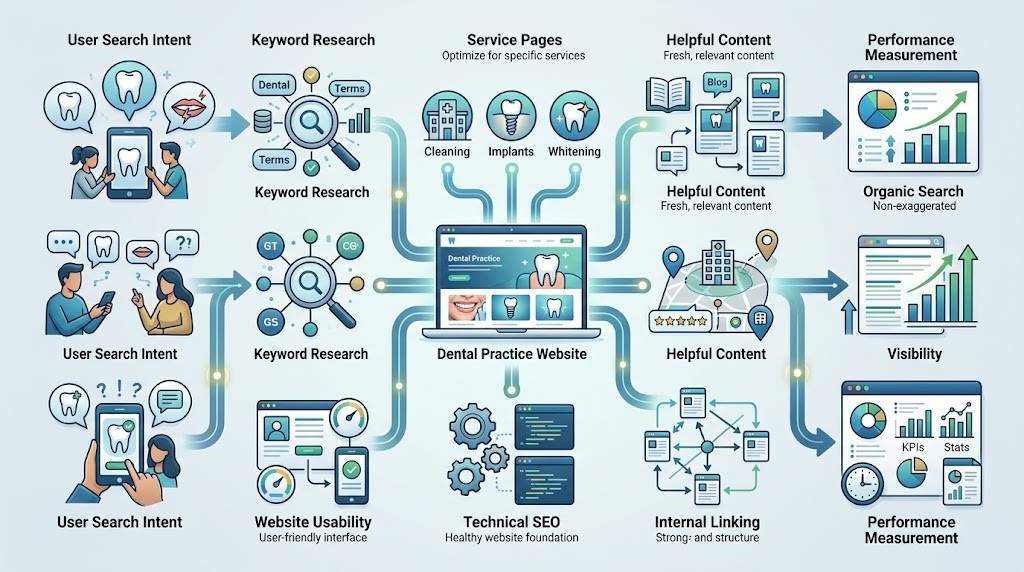
Step 1: Define the Practice’s Goals
Start by determining what the practice actually wants to accomplish.
Goals might include:
- Improving local visibility
- Increasing awareness of a particular service
- Educating prospective patients
- Improving website usability
- Strengthening the practice’s overall online presence
Clear goals help determine which SEO activities deserve priority.
Step 2: Understand the Audience
Consider:
- Location
- Services
- Patient needs
- Search behavior
- Decision-making stages
A practice should understand who it wants to reach and what those people may need from the website.
Step 3: Research Search Topics
Identify relevant:
- Services
- Questions
- Locations
- Treatment topics
- Educational subjects
Research should focus on relevance and intent rather than search volume alone.
Step 4: Map Topics to Pages
Decide where each topic belongs.
Possible destinations include:
- Homepage
- Service page
- Location page
- Blog article
- FAQ resource
This helps prevent several pages from competing for the same purpose.
Step 5: Optimize Existing Pages
Before creating large amounts of new content, review important existing pages.
Potential improvements include:
- Titles
- Headings
- Content
- Internal links
- Images
- Calls to action
- Navigation
Existing pages may already have useful information that can be improved.
Step 6: Improve Local Visibility
Make sure important business information is accurate and that local context is clear where appropriate.
This includes practice details, location information, contact options, and other relevant local signals.
Step 7: Create Helpful Content
Develop content around real questions and topics relevant to the practice.
Content should have a clear audience and purpose rather than being created solely to target additional keywords.
Step 8: Monitor Performance
Review relevant search and business signals over time.
Use the information to determine which areas are performing well, which pages may need refinement, and where new opportunities may exist.
How an SEO Agency Can Support Dental Marketing
Some practices have the internal expertise and resources to manage SEO themselves. Others may prefer outside support for strategy, technical work, content, or ongoing optimization.
An SEO agency may assist with:
- Strategy development
- Technical SEO
- Content planning
- Local SEO
- Keyword research
- Website optimization
- Reporting
For practices considering working with a dental SEO agency, the important question is not simply whether an agency offers SEO. The practice should understand what work will actually be performed, how the strategy will be developed, how communication will work, and how performance will be evaluated.
Outside support can provide specialist knowledge, but the practice still needs to remain involved in important decisions and provide accurate information about its services, locations, and priorities.
Dental SEO Services That Support Marketing Goals
Different SEO activities can contribute to different marketing objectives.
For example:
- Technical SEO can support website accessibility and structure.
- Local SEO can improve the clarity of geographic information.
- Content optimization can make existing resources more useful.
- Service-page optimization can strengthen important treatment pages.
- Internal linking can help visitors discover related information.
- Search-intent research can inform content and page planning.
- Performance monitoring can help guide future decisions.
The exact combination depends on the practice.
SEO solutions for dental practices may include several of these activities, but practices should always evaluate the actual scope of work rather than assuming every SEO package is structured the same way.
The marketing objective should determine the SEO activity—not the other way around.
Measuring Dentist SEO Marketing Performance
A dental practice should avoid judging SEO marketing through a single number.
Useful performance indicators can include:
- Organic impressions
- Organic clicks
- Search queries
- Landing-page performance
- Local visibility
- Relevant website actions
- Phone calls
- Appointment inquiries
- Conversion data where properly measurable
It is useful to distinguish between SEO activity metrics and business outcome metrics.
SEO activity metrics can include impressions, clicks, rankings, technical improvements, content published, and pages optimized.
Business outcome metrics may include relevant inquiries, phone calls, appointment requests, or other measurable actions.
Neither category tells the entire story on its own.
For example, increased impressions may indicate greater search visibility, but impressions do not necessarily mean that the practice received more qualified inquiries. Similarly, a change in organic traffic may be influenced by seasonality, search demand, website changes, competitors, or other factors.
SEO data is valuable for decision-making, but it should be interpreted within the broader marketing and business context.
Common Dental SEO Marketing Mistakes
Targeting Keywords Without Intent
A keyword may look attractive in research data but still be a poor fit for the page.
Content should be created around what users are actually trying to accomplish.
Publishing Unrelated Content
Generating traffic from unrelated subjects does not necessarily help a dental practice achieve meaningful marketing objectives.
Content should remain connected to the practice, its audience, and its services.
Creating Too Many Thin Pages
Creating separate pages for every small keyword variation can result in repetitive content and a confusing website structure.
Quality and usefulness should guide page creation.
Ignoring Local Search
A practice that serves a defined geographic market should consider how clearly its location and business information are communicated online.
Treating SEO as a One-Time Project
Websites change, competitors publish new content, services evolve, and search behavior changes.
SEO therefore often requires ongoing review rather than a single optimization project.
Using Keyword Stuffing
Repeating phrases unnaturally can make content harder to read and may reduce its usefulness.
Keywords should appear naturally when they help communicate the subject.
Buying Low-Quality Links
Large quantities of irrelevant or manipulative backlinks should not be treated as a shortcut to authority.
A sustainable strategy should prioritize relevance and quality.
Ignoring Website Experience
Visitors need a website that is easy to navigate, readable on mobile devices, and clear about the practice’s services and contact options.
Measuring Only Rankings
Rankings can be useful to monitor, but they should be considered alongside visibility, traffic, landing-page performance, relevant actions, and other appropriate business signals.
Dentist SEO Marketing for Different Practice Types
A search-focused strategy can vary according to the practice’s services and audience.
General Dental Practices
General practices may need broad local visibility combined with service-focused pages covering routine and preventive dental services.
Cosmetic Dental Practices
Cosmetic practices may place greater emphasis on treatment education, service information, and content that helps prospective patients understand available options.
Emergency Dentists
Emergency practices may need clear information, strong local relevance, accessible contact details, and content addressing urgent search intent.
Pediatric Dentists
Pediatric practices often communicate primarily with parents and guardians.
Their content strategy may therefore need to explain children’s dental services in language that is understandable to adults researching care for their children.
Multi-Location Practices
Multi-location practices need a careful balance between consistent business information and genuinely useful location-specific content.
Each location should provide meaningful information rather than simply repeating the same page with a different city name.
A pediatric dental search strategy can provide additional context for practices that specifically serve children and families.
How to Prioritize Dental SEO Marketing Activities
Not every SEO task needs to happen at the same time.
A practical prioritization framework can help a practice focus its resources.
High Priority
Start with issues that can have a direct effect on website usability, accessibility, or important search pages.
These may include:
- Technical problems affecting indexing
- Important service pages
- Accurate business information
- Mobile experience
- Critical website issues
Medium Priority
Once foundational issues are addressed, practices may focus on:
- Content improvements
- Internal linking
- Supporting educational content
- Local content
- Additional service-page improvements
Ongoing
Some SEO activities require continued attention:
- Performance monitoring
- Content updates
- Technical maintenance
- Strategic refinement
- Website improvements
Priorities should always depend on the individual practice and website.
A technical issue affecting an important service page may deserve attention before creating another blog article, while a practice with strong technical foundations may benefit more from improving content coverage.
How to Evaluate a Dental SEO Marketing Provider
When considering professional support, a practice should evaluate the provider beyond its sales presentation.
Important criteria include:
- Relevant experience
- Clear strategy
- Transparent deliverables
- Reporting
- Communication
- Technical knowledge
- Content quality
- Local SEO expertise
- Ethical practices
- Realistic expectations
Ask what the provider will actually do, how work will be prioritized, how results will be reported, and how the strategy will change when new information becomes available.
Practices comparing providers can use finding the right dental SEO provider as part of a broader evaluation process.
The goal should be to find a provider whose approach fits the practice’s needs rather than choosing an agency simply because it makes the strongest marketing claims.
Frequently Asked Questions
What is dentist SEO marketing?
Dentist SEO marketing is the use of search engine optimization as part of a dental practice’s broader marketing strategy. It can involve search-intent research, technical SEO, local visibility, service pages, useful content, website optimization, internal linking, and performance measurement.
How does SEO help dental marketing?
SEO can help a dental practice make useful information and service pages more discoverable through relevant organic searches. It can support awareness, consideration, and practice discovery, although search visibility does not guarantee patients or appointments.
Is SEO better than Google Ads for dentists?
Neither is universally better. SEO focuses on organic search visibility and ongoing website improvement, while Google Ads provides paid visibility through advertising campaigns. A practice may use both depending on its goals, market, budget, and marketing strategy.
How long does dental SEO marketing take?
There is no universal timeline. Results can vary according to website history, competition, location, technical condition, content quality, existing authority, search demand, and the consistency of implementation.
What content should a dental practice publish?
Content should address relevant questions and services that matter to the practice’s audience. Examples include dental FAQs, treatment guides, preventive-care information, children’s dental topics, appointment preparation, and general educational resources.
Does local SEO matter for dentists?
Local SEO can be particularly relevant because many dental searches include geographic intent. Accurate business information, location relevance, practice details, and responsible review management can all be part of a local strategy.
Should a dentist hire an SEO agency?
Not necessarily. Some practices can manage SEO internally if they have sufficient expertise and time. Others may benefit from specialist support. The decision should depend on the practice’s resources, website complexity, competition, goals, and internal capabilities.
How should dental SEO performance be measured?
Performance should be evaluated using multiple relevant signals, such as impressions, clicks, search queries, landing-page performance, local visibility, website actions, inquiries, calls, and measurable conversions where appropriate. Rankings alone should not be the only measure.
Can dentist SEO marketing guarantee new patients?
No responsible SEO strategy should guarantee a specific number of new patients. Search visibility and marketing performance are influenced by many factors, including competition, user behavior, website experience, market conditions, and the practice’s overall marketing and operations.
Final Thoughts
Dentist SEO marketing is broader than keyword optimization.
A useful strategy can connect search-intent research, technical SEO, local visibility, service pages, helpful content, website usability, internal linking, performance measurement, and broader marketing activities.
The most effective approach is not necessarily the one that produces the largest number of pages, keywords, or reports. It is the one that helps a dental practice make informed decisions about how its website serves prospective patients and how its online presence can become more relevant to appropriate searches.
SEO can work alongside paid advertising, social media, email, reputation management, branding, community marketing, and referrals. Each channel can have a different role, and practices should evaluate them according to their own objectives and resources.
For dental practices considering professional SEO support, the most important factors are a clear strategy, relevant expertise, useful content, sound technical work, responsible local optimization, transparent reporting, and realistic expectations.
Sustainable search marketing is not about shortcuts or guaranteed outcomes. It is about continually improving the website and marketing strategy so that the practice can provide useful information and become easier to discover when people conduct relevant searches.


