
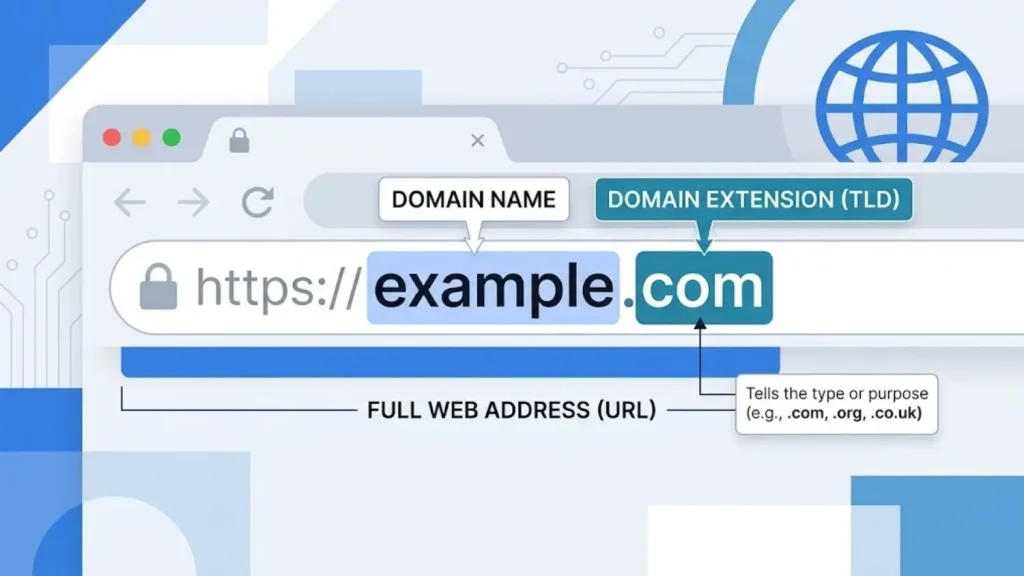
When you look at a website address, you will often see an ending such as .com, .org, or .net. This ending is commonly called a domain extension. It is one of the most recognizable parts of a web address, but it is easy to confuse it with the domain name or the full URL.
So, what does domain extension mean? In everyday internet terminology, a domain extension is the ending of a domain name, such as .com in example.com. Technically, these endings are usually discussed as top-level domains, or TLDs.
Understanding the difference can help you choose a domain, explain your website address clearly, and avoid common registration mistakes.
What Is an Example of a Domain Extension?
Consider brightbusiness.com. In this example:
brightbusinessis the name registered before the extension..comis the domain extension, or top-level domain.brightbusiness.comis the complete domain name.
Now consider brightbusiness.co.uk. This is a commonly used multi-part domain ending. The exact technical structure depends on the domain hierarchy and registry conventions, so not every ending with multiple labels should be treated as one single TLD.
For a deeper explanation of how top-level domains work, explore our guide to the structure of top-level domains.
Common Types of Domain Extensions
Domain extensions come in different categories. Each category has its own purpose, conventions, and sometimes registration requirements.
.com
.com originally referred to commercial use but is now widely used by businesses, blogs, publishers, creators, and other website owners. It is familiar to many internet users and can work for a broad range of brands.
Its popularity does not mean it is the right choice for every website. Availability, name quality, price, and audience fit still matter. Our guide explains what .com means and why it is widely used.
.org
.org is commonly associated with organizations, including nonprofits and community projects. Its use is not limited to one universal type of organization, so visitors should not assume a website’s legal status or credibility from the extension alone.
.net
.net was originally associated with network-related uses and is now used by a variety of websites. It can be an alternative when a preferred .com name is unavailable, provided the extension fits the brand.
Country-Code Extensions
Country-code top-level domains are associated with countries or territories. Examples include .uk, .ca, and .au. They may suit businesses that focus on particular markets, but registration requirements vary by extension.
Newer and More Specific Extensions
Extensions such as .shop, .design, and .technology can communicate a theme or industry. They may be useful for branding, but the extension should still be easy to recognize and appropriate for the intended audience.
Is a Domain Extension the Same as a URL?
No. A domain extension is only one part of a domain name, and a domain name is only one component of a URL.
For example, in https://www.example.com/products:
https://is the protocol.wwwis a subdomain.example.comis the domain name..comis the extension, commonly identified as the TLD./productsis the path to a particular page or resource.
A URL can contain additional elements, such as query parameters or a fragment identifier. The domain extension alone does not tell you which page a visitor will reach.
Does Your Domain Extension Affect SEO?
A domain extension does not automatically make a website rank higher. Search performance depends on many factors, including how well a page meets search intent, content usefulness, technical accessibility, site structure, and other ranking signals.
A country-code extension may be relevant to geographic targeting, while a generic extension can be suitable for a broader audience. However, selecting .com or another popular ending is not a replacement for sound SEO practices.
Choose an extension based on your audience, branding, eligibility, and long-term plans. Then focus on publishing useful content and maintaining a website that visitors can navigate easily.
How to Choose the Right Domain Extension
Before registering a domain, consider these questions:
- Who is your audience? A local business and an international publisher may have different needs.
- Does the name fit your brand? Keep the complete domain easy to spell and remember.
- Is the extension available to you? Check any registry restrictions or eligibility rules.
- What will it cost over time? Compare registration and renewal fees rather than looking only at an introductory price.
- Could it create confusion? Check similar names and relevant trademarks before committing.
The best extension is the one that fits the website’s purpose and can be used consistently across marketing, email, and other business communications.
Final Thoughts
A domain extension is the ending people see in a domain name, such as .com, .org, or .net. It is often used as a general term for a top-level domain, although technical domain structures can be more detailed.
Understanding the extension, the complete domain name, and the full URL helps you make better choices when setting up a website. Select a domain that suits your audience and brand, then support it with useful content and a reliable website experience.


