

Finding the best large language model (LLM) for math can be challenging. These models help solve complex problems and improve learning.
Math can be tough, but with the right tools, it gets easier. LLMs are advanced AI models designed to understand and generate human-like text. They can assist in solving math problems, explaining concepts, and even tutoring. With many options available, choosing the right LLM for math is essential.
This guide will explore the top models, their features, and how they can help you improve your math skills. Whether you are a student, teacher, or math enthusiast, finding the best LLM can make a big difference in your learning experience.
Importance Of An LLM for Math
Large Language Models (LLMs) are transforming the way we approach mathematics. These advanced AI models, trained on vast datasets, can interpret, solve, and even explain complex mathematical problems in a human-like manner. Their importance in the field of math is growing rapidly across education, research, and industry.
Enhanced Problem-Solving
LLMs can solve various mathematical problems—from basic arithmetic to advanced calculus and linear algebra. They understand mathematical syntax, formulas, and symbols and can generate step-by-step solutions. This makes them powerful tools for learners, educators, and professionals alike.
Instant Conceptual Support
Math often requires deep conceptual understanding, and LLMs can provide instant explanations, clarify doubts, and even offer alternative methods for solving problems. Unlike traditional calculators or symbolic engines, LLMs can adapt their responses based on how the question is framed, making them ideal for dynamic problem-solving and tutoring.
Versatility Across Domains
Whether in data science, engineering, finance, or theoretical physics, LLMs can tackle math problems relevant to various domains. They can interpret complex data structures, generate code for simulations, or assist in modeling real-world scenarios—all by understanding the mathematical context.
Accelerating Research and Innovation
In research settings, LLMs can assist with tasks like equation generation, literature review involving mathematical notation, and even proposing new approaches to unsolved problems. They help researchers save time and focus on deeper insights rather than routine computations.
Democratizing Math Education
With LLMs accessible through chatbots and educational platforms, high-quality math support is now available to anyone with an internet connection. This levels the playing field for learners worldwide, especially those without access to traditional tutoring or resources.

Credit: www.bracai.eu
Top LLM Models for Math: The Best AI Tools to Solve Complex Problems
Large Language Models (LLMs) are reshaping how we interact with math. These AI-powered tools go beyond simple calculators—they interpret problems, provide step-by-step solutions, and even offer conceptual explanations. Below is a comprehensive look at the top LLMs currently excelling in mathematical problem-solving, education, and research.
1. OpenAI’s GPT-4 (and GPT-4 Turbo)
OpenAI’s GPT-4 is one of the most powerful general-purpose language models. It has a strong aptitude for math across all levels. It benefits symbolic reasoning, problem breakdowns, and generating code-based solutions. Its math capabilities become even more advanced when paired with tools like Python or Wolfram Alpha.
Strengths
- Handles algebra, calculus, statistics, and logic with high accuracy
- Offers detailed, step-by-step explanations
- Can generate code for solving and simulating mathematical problems
- Integrates with tools like Python and Wolfram Alpha for deeper functionality
Limitations
- Can occasionally produce incorrect results without external tool integration
- May misunderstand vague or poorly worded questions
Best Use Cases
- Math tutoring for students at all levels
- Content creation for math education platforms
- Writing code to model or solve math-based real-world problems
2. Google Gemini (formerly Bard Advanced)
Thanks to DeepMind’s training approaches, Google Gemini blends large language modeling with advanced reasoning. Although it’s not specialized in math, it is particularly good at solving applied problems and interpreting real-world language in a mathematical context.
Strengths
- Excels at translating word problems into solvable equations
- Strong at applied mathematics and business-related calculations
- Integrates with Google Workspace tools like Sheets
- Intuitive responses and helpful contextual understanding
Limitations
- Struggles with advanced symbolic math or abstract theoretical questions
- Some features are still in limited release depending on location
Best Use Cases
- Solving everyday math problems in education or business
- Quick help with applied math, finance, or statistics
- Supporting school-level or college-level learners with real-time explanations
3. Anthropic Claude 3
Claude 3, developed by Anthropic, emphasizes safety, reasoning, and clarity. While it is not math-specific, it performs exceptionally well in logic-heavy math problems and is especially good for step-by-step walkthroughs and formal reasoning.
Strengths
- Excellent at structured, logical thinking
- Great for proof-based and set theory problems
- Retains conversational context over long sessions
- Clear and accessible explanations for abstract math topics
Limitations
- Less suitable for symbolic computation or numeric-heavy calculations
- Not integrated with math engines like Wolfram
Best Use Cases
- Teaching logical reasoning and proof construction
- Explaining math theory in a simplified manner
- Supporting students learning abstract math topics like logic or discrete math
4. Wolfram Alpha (via GPT-4 Plugin or API)
Wolfram Alpha is not an LLM itself but is the gold standard for symbolic math and scientific computing. When used in conjunction with GPT-4 or other models via plugins, it becomes a powerhouse for precision-based math solving.
Strengths
- Performs exact symbolic and numeric calculations
- Solves calculus, algebra, and linear algebra with accuracy
- Generates graphs, charts, and data visualizations
- Ideal for research-level mathematics and academic applications
Limitations
- Not conversational by itself—relies on LLM integration for natural interaction
- Overkill for casual or basic math needs
Best Use Cases
- Solving higher-level math equations with complete accuracy
- Creating technical visualizations or advanced plots
- Research projects in engineering, physics, or applied math
5. MATH-GPT (by Google DeepMind)
MATH-GPT is a math-specialized LLM developed to outperform general models on mathematical tasks. It is explicitly trained on datasets containing complex math problems and has shown superior performance on academic benchmarks like MATH and GSM8K.
Strengths
- Trained exclusively on math-related data for high accuracy
- Understand LaTeX and advanced symbolic notation
- Performs well on math competition-style problems
- Minimizes common errors made by general-purpose LLMs
Limitations
- Still under limited access for public use
- Less conversational and flexible than broader LLMs
Best Use Cases
- Solving academic-level and Olympiad-grade math problems
- Assisting in proof-based research and formal reasoning
- Providing structured solutions to high-difficulty questions
6. Meta’s LLaMA + MathInstruct Fine-Tunes
Meta’s LLaMA is an open-source family of models, and several fine-tuned versions now exist that focus specifically on math. These models are popular in research and education technology due to their flexibility and ease of customization.
Strengths
- Open-source and adaptable for math education tools
- Can be privately hosted or fine-tuned for domain-specific needs
- Performs well in structured environments like classrooms or LMS platforms
Limitations
- Requires technical knowledge for deployment and fine-tuning
- Not as performant out-of-the-box as commercial models like GPT-4
Best Use Cases
- Building custom math tutoring applications
- Academic research environments needing tailored models
- Deploying offline AI support in schools or universities
7. ChatGPT Code Interpreter (Python Mode)
The ChatGPT Code Interpreter, or Advanced Data Analysis (ADA) mode, allows GPT-4 to run Python code in real time. While it’s not a standalone LLM, this feature dramatically enhances the model’s math abilities, especially for computations and visualizations.
Strengths
- Runs real Python code for actual computation
- Visualizes data, functions, and equations effectively
- Ideal for combining programming and math education
- Supports tasks like regression, optimization, and simulation
Limitations
- Requires some basic programming understanding to use effectively
- Only available in ChatGPT Pro or enterprise versions
Best Use Cases
- Real-time math problem solving with live code execution
- Teaching programming and applied math together
- Analyzing data sets, creating models, and plotting graphs
Each of these LLMs offers unique strengths when it comes to mathematics. GPT-4 remains the most versatile for many users, especially when enhanced with tools like Wolfram Alpha or Python. For specialized tasks, models like MATH-GPT or fine-tuned LLaMA versions shine in focused applications. Whether you’re an educator, researcher, or student, selecting the right model depends on your depth of need, desired interactivity, and the type of math you’re working with.
Key Features to Look for in the Best LLM for Math
When choosing the best LLM for math, it’s essential to go beyond brand names and focus on what actually matters for your use case. Whether you’re a student looking for homework help, a teacher building curriculum content, or a researcher exploring advanced concepts, the right features can make all the difference.
Mathematical Accuracy
The most important feature is the model’s ability to solve problems accurately. Look for LLMs that perform well on math benchmarks and can handle symbolic reasoning, algebra, calculus, and logic-based questions with minimal error.
Step-by-Step Reasoning
A good math LLM should break down problems clearly, showing every step involved. This is especially valuable for learners and educators who want to understand the logic behind the answer—not just the solution.
Contextual Understanding
LLMs that understand the intent behind word problems or technical descriptions are more useful. This includes translating real-world problems into equations and interpreting ambiguous or conversational math queries correctly.
Support for Code and Computation
If you’re working on data science, simulations, or applied math, LLMs with integrated code execution or Python support can solve problems, generate graphs, and run models in real-time—offering a big advantage.
Compatibility with Tools
Check if the model integrates with powerful external tools like Wolfram Alpha, graphing calculators, or spreadsheets. These integrations greatly extend the model’s capabilities in solving high-precision or visual math problems.
Customization and Scalability
For educational institutions or businesses, LLMs that allow fine-tuning or private deployment (like Meta’s LLaMA) offer control and scalability. This is especially useful for building your own math assistants or curriculum-based tools.
Choosing the right LLM means aligning these features with your goals—whether it’s casual learning, professional application, or deep research.
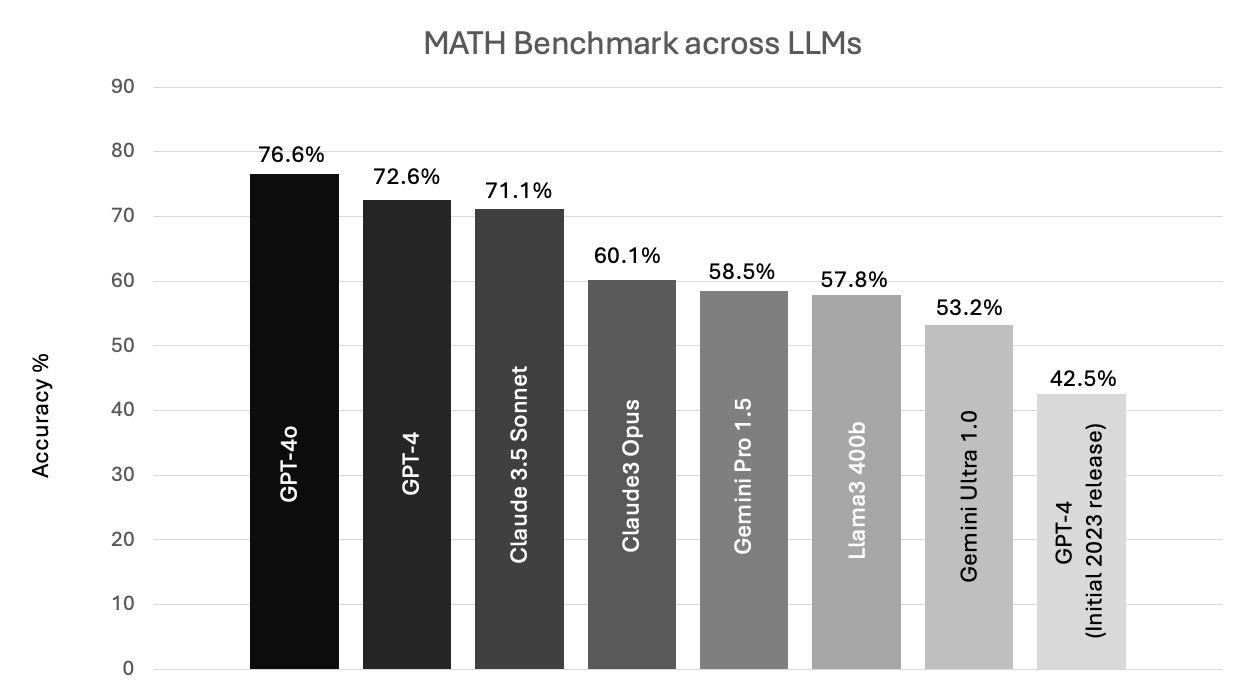
Credit: www.reachcapital.com
Conclusion
Choosing the best LLM for math depends on your specific goals—whether it’s learning, teaching, research, or application. From GPT-4’s versatile reasoning to Wolfram Alpha’s precision and MATH-GPT’s specialized focus, each model brings unique strengths to the table. Focus on key features like accuracy, step-by-step reasoning, and tool compatibility to find the right fit. With the right LLM, tackling math becomes faster, smarter, and more accessible than ever.


